

Foundational Overview: What is Agile Methodology and Why It Matters
Agile methodology is not merely a project management process; it is a fundamental mindset and collaborative framework designed for delivering value in complex, uncertain environments. At its core, Agile is about adaptability, customer collaboration, and iterative progress over rigid planning and documentation. In today’s fast-paced world, where requirements evolve and market feedback is instantaneous, understanding and implementing Agile is critical for teams and organizations seeking to innovate, reduce risk, and deliver what customers actually want.
Table of Contents
The Core Definition and Scope
Agile is an umbrella term for a set of values, principles, and practices that prioritize flexibility, teamwork, and customer feedback. Its scope extends beyond software development—where it originated—to marketing, product development, HR, and even event planning. The Agile scope is defined by iterative work cycles (sprints or iterations), continuous improvement, and a focus on working deliverables as the primary measure of progress.
Historical Context and Evolution [UPDATE: 2026]
The Agile methodology was formally born in 2001 with the signing of the Agile Manifesto by seventeen software developers. It emerged as a reaction to the inefficiencies of heavyweight, document-driven “waterfall” processes. Since then, it has evolved from a niche software approach to a mainstream business philosophy. By 2026, Agile has matured beyond its initial frameworks (like Scrum and XP) into sophisticated hybrid and scaling models (like SAFe, LeSS, and Disciplined Agile) that allow large enterprises to harness agility while maintaining necessary governance and alignment.
The “Magic Triangle”: Interconnected Principles That Govern Success
Agile success is governed by an interconnected triangle of principles:
- Individuals and Interactions over processes and tools.
- Working Software (or Deliverables) over comprehensive documentation.
- Customer Collaboration over contract negotiation.
- Responding to Change over following a plan.
The items on the right are valued, but the items on the left are valued more. This prioritization forms the bedrock of the Agile mindset.
The Complete Classification System
Primary Types and Models
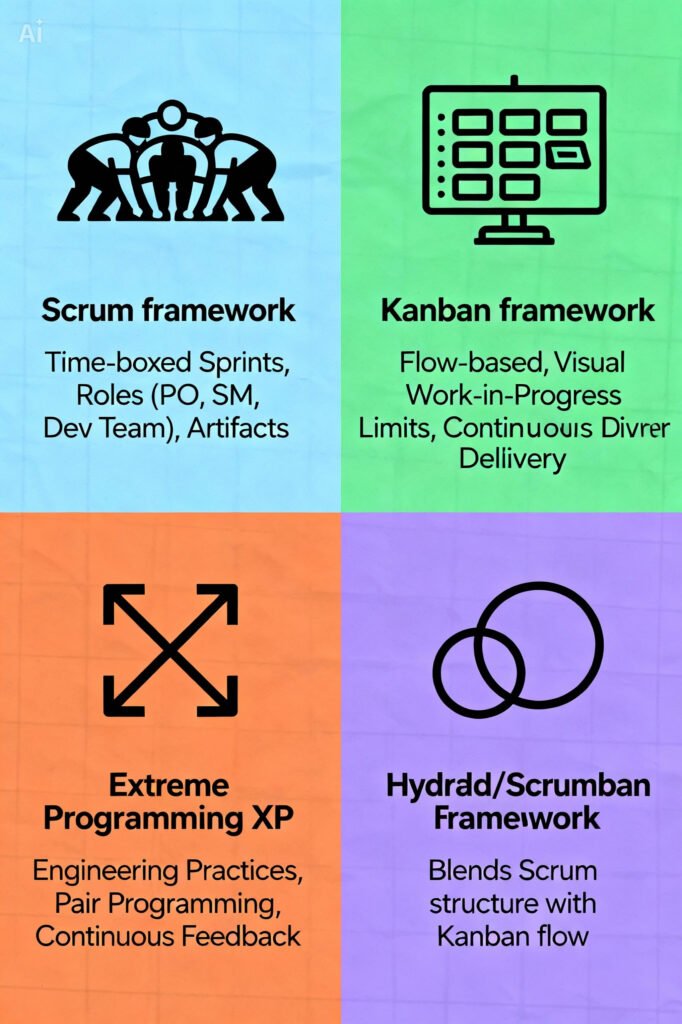
Agile is implemented through specific frameworks. Scrum is the most popular, providing a structured, time-boxed approach. Kanban focuses on visualizing work and limiting work-in-progress for continuous flow. Extreme Programming (XP) emphasizes technical excellence. Lean focuses on eliminating waste. Most organizations use a tailored blend.
Scale Variations: From Residential to Commercial Applications
- Team-Level (“Residential”): A single, co-located or remote team of 5-9 people using Scrum or Kanban to manage their product backlog. This is the foundational unit of agility.
- Program/Portfolio-Level (“Commercial”): Multiple agile teams (an “Agile Release Train”) coordinated through scaled frameworks like SAFe (Scaled Agile Framework) or LeSS (Large-Scale Scrum) to deliver complex solutions, requiring additional roles, ceremonies, and synchronization.
Regional/Climate-Based Adaptations
While Agile principles are universal, implementation adapts to regional culture. In consensus-driven cultures (e.g., Japan), aspects of Lean and Kanban may integrate more naturally. In more hierarchical cultures, the shift to self-organizing teams requires significant change management.
The End-to-End Lifecycle Framework
Phase 1: Initiation and Planning
This phase involves defining the product vision, creating a high-level product roadmap, and establishing the initial product backlog (a prioritized list of features/user stories). The team is formed, and working agreements are established.
Phase 2: Implementation and Execution
The core of Agile: iterative development cycles (Sprints in Scrum, typically 2-4 weeks). Each cycle includes Sprint Planning, Daily Stand-ups, development work, a Sprint Review (demo), and a Sprint Retrospective for continuous improvement. A working increment is delivered at the end of each cycle.
Phase 3: Operation and Maintenance
The product is in use. The team shifts to a Kanban-style flow for ongoing maintenance, bug fixes, and small enhancements, while also planning for larger new features in future sprints. Continuous delivery pipelines ensure stable releases.
Phase 4: Optimization and Scaling
The team and processes are refined. Metrics like velocity, cycle time, and customer satisfaction are analyzed. If successful at the team level, the organization may scale agility to coordinate multiple teams working on interconnected products.
Phase 5: Renewal or Replacement
Products may reach end-of-life, prompting a pivot or sunset. The Agile framework itself is also subject to renewal; teams regularly inspect and adapt their processes in retrospectives, and organizations may evolve their scaling framework based on outcomes.
Key Stakeholders and Ecosystem Dynamics
Roles and Responsibilities Matrix
- Product Owner (PO): Maximizes product value. Manages the backlog, prioritizes work, and defines “what” to build.
- Scrum Master (SM)/Agile Coach: Facilitates the process, removes impediments, and coaches the team on Agile practices. Servant leader.
- Development Team: Cross-functional group that does the work of delivering the increment. Self-organizing and accountable.
- Stakeholders/Customers: Provide feedback during reviews and collaborate with the PO to shape the product.
Communication Protocols and Documentation Standards
- Ceremonies: Daily Stand-up (15-min sync), Sprint Planning, Review, and Retrospective provide structured communication rhythms.
- Artifacts: Product Backlog, Sprint Backlog, and Increment are “live” documents, constantly updated. Working software is the primary documentation.
- Informal Communication: High bandwidth, face-to-face (or video call) conversation is favored over lengthy email chains.
Regulatory and Compliance Landscape
In regulated industries (finance, healthcare), Agile must be adapted to meet audit and documentation requirements. This often involves “Agile-Gating”—embedding necessary approvals and documentation within sprints without breaking the flow. Frameworks like Disciplined Agile (DA) provide toolkits for these scenarios.
Tools, Technology, and Performance Management
Essential Tools and Software Solutions
- Visual Management: Digital Kanban boards (Jira, Trello, Azure DevOps) are essential for tracking work and limiting WIP.
- Collaboration: Tools like Slack, Teams, and Miro facilitate the high level of communication and collaboration Agile requires.
- CI/CD Pipelines: Technology for Continuous Integration and Continuous Delivery (e.g., Jenkins, GitLab CI) is critical for fast, reliable releases. (e.g., [MENTION A POPULAR AGILE TOOL SUITE]).
Key Performance Indicators (KPIs) and Metrics Dashboard
Move beyond vanity metrics to outcome-based measures:
- Outcome Metrics: Customer Satisfaction (NPS/CSAT), Release Frequency, Business Value Delivered.
- Process Metrics: Velocity (for forecasting), Cycle Time/Lead Time (for efficiency), Sprint Burndown (for daily progress).
- Health Metrics: Team Happiness, Retrospective Action Completion.
Data-Driven Decision Making Framework
Agile decisions are informed by empirical data:
- Transparency: Make all work and metrics visible on boards and dashboards.
- Inspection: Regularly review the product (Sprint Review) and process (Retrospective).
- Adaptation: Adjust the backlog, processes, or even team composition based on inspection findings.
Comparative Analysis and Strategic Decision Matrix
Side-by-Side Comparison Table
| Option | Best For Scenario | Advantages | Limitations | Cost Range | Skill Required |
|---|---|---|---|---|---|
| Scrum | Teams new to Agile, projects with evolving requirements needing regular feedback. | Clear roles & structure, time-boxed predictability, strong focus on incremental value. | Can be rigid, requires full team commitment, may create “sprint pressure.” | Low (Framework is free; tooling varies) | Facilitation (SM), Prioritization (PO), Collaboration. |
| Kanban | Teams with ongoing, support-like work, or those seeking to start Agile with minimal change. | Highly flexible, visualizes workflow, improves flow efficiency, easy to start. | Less prescriptive, can lack time-boxed rhythm for planning, requires discipline. | Low (Framework is free; tooling varies) | Process analysis, WIP limit discipline. |
| Scaled Agile (SAFe/LeSS) | Large organizations (100+ people) with multiple interdependent teams needing alignment. | Provides structure for scale, aligns teams to business goals, manages dependencies. | Can become bureaucratic, significant training/coaching investment, complex. | High (Training, consulting, tooling) | Enterprise change management, advanced coaching. |
Risk Assessment and Mitigation Strategies
- Risk: Implementing Agile as a process change without a mindset shift (“Cargo Cult Agile”).
- Mitigation: Invest in coaching, focus on principles over practices, and lead by example.
- Risk: Lack of stakeholder buy-in leading to pressure to skip ceremonies or revert to old ways.
- Mitigation: Involve stakeholders early, demonstrate value through frequent demos, and educate on the “why.”
- Risk: Scaling prematurely before achieving stable team-level agility.
- Mitigation: Master agility at the team level first. Let the need to solve real coordination problems drive scaling, not a mandate.
Future Trends and Innovations [UPDATE: 2026]
The future of Agile methodology is enterprise business agility, where the entire organization—from HR to finance—operates with Agile principles. AI and machine learning are being integrated into Agile tools for predictive forecasting, automated testing, and backlog refinement. Furthermore, the rise of remote/hybrid work has cemented the need for digital-first Agile practices and tools that foster collaboration across distances.
Implementation Roadmap and Resources
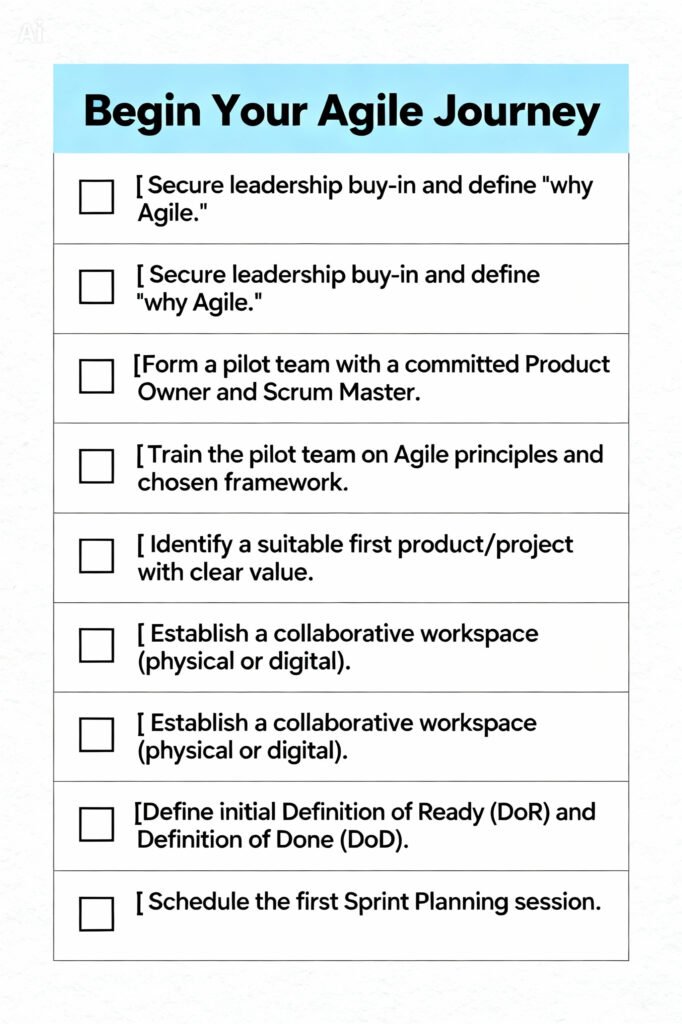
Actionable Checklist for Getting Started
Common Pitfalls and How to Avoid Them
- Pitfall: The Product Owner is also the team’s manager, creating conflict.
- Avoid: Clearly separate the PO role (value decision-maker) from the people-manager role.
- Pitfall: Daily Stand-ups become status reports to the manager.
- Avoid: Keep it for the team. Focus on plans, impediments, and collaboration, not detailed reporting.
- Pitfall: Skipping Retrospectives or not acting on findings.
- Avoid: Protect retro time. Prioritize one actionable improvement each sprint and track it.
Recommended Next Steps Based on Your Goals
- “I need to understand Scrum basics.” → [Read our deep dive into the Scrum framework].
- “We are adopting Agile for the first time.” → Follow our step-by-step Agile implementation guide.
- “How does Agile fit with the PMP?” → See our guide to Agile for the PMP exam.
- “We’re growing and need to scale.” → Explore our comparison of scaling frameworks.
Reference Section
Key Takeaways and Summary
- Agile is a mindset and value system focused on adaptability, collaboration, and customer value, implemented through frameworks like Scrum and Kanban.
- Success requires a balance of empowered roles (PO, SM, Team), iterative cycles, and a commitment to continuous improvement.
- Agile scales from single teams to large enterprises using frameworks like SAFe, but team-level agility should be mastered first.
- The right tools and outcome-based metrics (not just output metrics) are essential for sustaining agility.
- The future of Agile is full enterprise agility, enhanced by AI and built for hybrid work environments.
Complete Glossary of Terms
- Agile Manifesto: The foundational 2001 document stating the four values and twelve principles.
- Sprint: A time-boxed iteration (usually 2-4 weeks) in Scrum where a “Done” increment is created.
- Product Backlog: An ordered list of everything that is known to be needed in the product.
- User Story: A simple description of a feature told from the perspective of the user.
- Velocity: A measure of the amount of work a team can complete in a sprint, used for forecasting.
- Scrum Master: A servant-leader who ensures the team follows Agile practices and removes obstacles.
- Product Owner: The person responsible for maximizing the value of the product and managing the backlog.
- Kanban Board: A visual workflow management tool that limits work-in-progress.
- CI/CD: Continuous Integration and Continuous Delivery, the technical practice of frequently merging code and releasing.
Frequently Asked Questions
Q: What is the main difference between Agile and Scrum?
A: Agile is the overarching philosophy and set of principles. Scrum is a specific, popular framework for implementing Agile, with defined roles, events, and artifacts.
Q: Can Agile work for non-software projects?
A: Absolutely. The principles of iterative work, customer collaboration, and adapting to change apply to marketing campaigns, product design, event planning, and any complex project.
Q: How long is a typical sprint?
A: While two weeks is common, sprints can be 1-4 weeks. The key is that the length remains consistent once chosen to create a reliable rhythm.
Q: Do we need a dedicated Scrum Master?
A: Ideally, yes, especially when starting. The role is a full-time facilitation and coaching role, not a part-time administrative task. In mature teams, the role may be shared.
Q: What is the difference between a Product Owner and a Project Manager?
A: A Product Owner is focused on the “what” and “why”—maximizing product value. A traditional Project Manager is often focused on the “how,” “when,” and “cost”—managing the plan. In Agile, the team manages its own execution.
Q: How do we estimate work in Agile?
A: Common techniques include Story Points (relative sizing using Fibonacci numbers) or T-Shirt Sizing (S, M, L, XL). The goal is relative estimation for forecasting, not precise hours.
Q: What does “Definition of Done” mean?
A: It is a shared agreement within the team on the criteria a product increment must meet to be considered complete and potentially shippable. It ensures quality and shared understanding.
Q: Is Agile against documentation?
A: No. Agile values working software over comprehensive documentation. It promotes “just enough” documentation that provides real value, not documentation for documentation’s sake.
Further Reading and Authoritative Sources
- The Agile Manifesto: The original source document. (https://agilemanifesto.org/)
- Scrum Guide: The definitive guide to the Scrum framework, updated by its creators. (https://scrumguides.org/)
- State of Agile Report: The annual industry survey by Digital.ai on Agile adoption trends and metrics. (Link to latest report)
- PMI’s Agile Practice Guide: A comprehensive guide co-published by PMI and Agile Alliance, excellent for bridging traditional and Agile practices.
Ready to bring agility to your team? Start your agile transformation with our free assessment tool and customized implementation playbook.
External Resources:
- Agile Alliance: The original global nonprofit community dedicated to promoting the concepts of the Agile Manifesto. (https://www.agilealliance.org/)
- Scrum.org: A leading resource for Scrum training, assessments, and the official Scrum Guide. (https://www.scrum.org/)
- Kanban University: The source for Kanban method training and certification. (https://kanban.university/)