

The PMP renewal process is the mandatory, structured system through which Project Management Professional (PMP)® certification holders maintain the active status of their credential. Managed by the Project Management Institute (PMI), it is not a re-test but a demonstration of continuous professional growth. Failure to correctly navigate this process can lead to a lapsed certification, requiring a more complex and expensive reinstatement.
Table of Contents
Core Concept Explained Simply
Think of your PMP certification as a three-year subscription. The renewal process is how you “re-subscribe.” Instead of paying full price again, you prove you’ve been keeping your skills updated by earning 60 Professional Development Units (PDUs) and paying a renewal fee before your “subscription” expires.
Key Terminology Breakdown
- CCR Cycle: Your three-year certification period. The clock starts the day you pass the exam.
- PDUs (Professional Development Units): The “currency” of renewal. You need 60 units, earned through Education and Giving Back activities.
- CCRS (Continuing Certification Requirements System): PMI’s online portal where you report PDUs and submit renewal.
- Audit: A random verification by PMI where you must provide proof for a sample of your claimed PDUs.
Historical Development and Current Context [UPDATE: 2026]
Originally, maintenance was less formalized. The current structured CCR cycle was implemented to ensure credential holders remain current in an evolving profession. In 2026, the system is fully digital via the CCRS, with an increased emphasis on the “Giving Back” category to foster community knowledge sharing. The core requirement of 60 PDUs over three years remains the steadfast benchmark.
How the PMP Renewal Process Actually Works: The Mechanism
Understanding the mechanism helps you avoid missteps.
Fundamental Principles
- Proactive Continuity: You must act before your cycle ends; the system does not auto-renew.
- Dual-Category Fulfillment: PDUs must be earned across two categories: a minimum of 35 in Education and a maximum of 25 in Giving Back.
- Documentation and Honesty: You are responsible for accurately reporting activities and retaining proof.
Process Flow Visualization
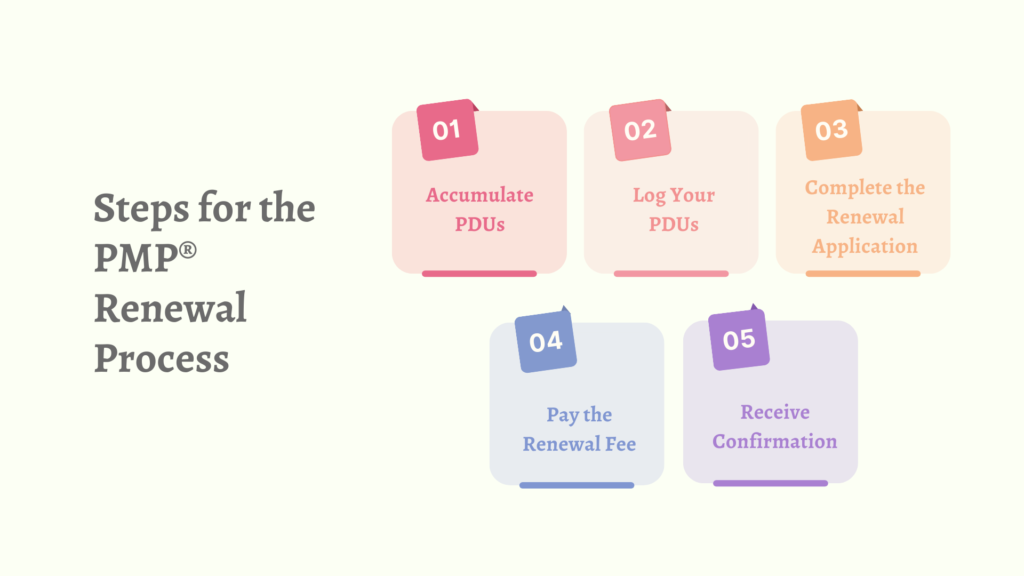
Inputs, Processes, and Outputs
- Inputs: Your time (for PDU activities), documentation (certificates, notes), and the renewal fee.
- Processes: Learning (courses, reading), sharing (volunteering, creating content), logging (CCRS entry), and payment.
- Outputs: An active PMP credential for a new three-year cycle and an updated professional skill set.
Components and Variations
Main Parts and Their Functions
- The CCR Cycle (The Timer): Defines the start and end date, creating urgency.
- PDU Categories (The Requirements): Education ensures skill currency; Giving Back ensures community contribution.
- The CCRS (The Control Panel): The interface for tracking, reporting, and submitting renewal.
- The Audit (The Quality Check): Ensures the integrity of the system.
Different Models and Configurations
While the 60-PDU model is standard for the PMP, other PMI credentials have different requirements (e.g., CAPM requires 15 PDUs). The PMP renewal process itself does not have configurable models; it is a fixed standard.
Industry-Specific Versions
The process is identical globally and across industries. However, the types of PDUs earned will vary. An IT PM might earn PDUs on Agile frameworks, while a construction PM might focus on safety regulations. The process accommodates all specializations.
Benefits, Applications, and Impact
Primary Advantages and Value Proposition
Successfully completing the renewal process maintains your professional credibility, marketability, and salary premium. It forces continuous learning, which directly enhances your on-the-job performance and strategic value.
Real-World Applications Across Industries
In every industry, the renewed credential is a trusted signal to employers, clients, and regulators of your commitment to professional standards. It is often a hard requirement for senior project management roles, consulting engagements, and contract bids.
Who Benefits Most and Why
- Active Project Managers: They benefit from protected employability and justified salary increases.
- Job Seekers: A currently active PMP is non-negotiable for most recruitment filters.
- The Profession: The collective renewal of practitioners raises the overall standard and reputation of project management.
Limitations and Considerations
Potential Drawbacks and Constraints
- Time Burden: Requires consistent effort over three years.
- Cost: Even with free PDUs, there is the renewal fee and potential course costs.
- Administrative Overhead: Requires diligent tracking and logging.
- Risk of Lapse: The consequence of forgetting or failing to complete the process is severe (credential loss).
Situations Where Alternatives Are Better
If you have already let your credential lapse, the renewal process is no longer an option. You must follow the more arduous reinstatement process. Understand the critical differences between renewal and reinstatement here.
Common Misconceptions Debunked
- Misconception: “If I earn more than 60 PDUs, the extra roll over to my next cycle.”
- Debunked: PDUs do not roll over. Any excess PDUs earned in a cycle are forfeited upon renewal.
- Misconception: “My day-to-day project work counts for PDUs.”
- Debunked: It does not. PDUs are for new learning or sharing knowledge, not applying existing skills.
- Misconception: “PMI will send me multiple reminders as my deadline approaches.”
- Debunked: While PMI may send some emails, the ultimate responsibility rests with you. Do not rely solely on reminders.
Frequently Asked Questions (8-10 Questions)
Q1: What is the most common mistake in the PMP renewal process?
A: The most common and costly mistake is procrastination—waiting until the final months of the cycle to earn PDUs. This leads to rushed, low-quality learning, potential audit issues, and high risk of missing the deadline.
Q2: Can I renew my PMP if I don’t have all my PDU certificates?
A: You can report PDUs without uploading certificates. However, if audited, you will need to provide proof. Not having certificates for claimed activities during an audit will result in those PDUs being rejected, potentially causing you to fail renewal.
Q3: What happens if I report a PDU in the wrong category?
A: This is a common error. If discovered before an audit, you can edit or delete the entry in CCRS. If discovered during an audit, PMI may reject the PDU. It’s crucial to understand the category rules before reporting.
Q4: Is it a mistake to only focus on “Education” PDUs and ignore “Giving Back”?
A: Not necessarily a mistake, but a missed opportunity. You can earn all 60 PDUs in Education. However, Giving Back PDUs are often easier and more fulfilling to earn (e.g., volunteering, writing an article). Maximizing this category can make the process easier.
Q5: How do I avoid a PMI CCR audit?
A: You cannot avoid it; audits are random. The goal isn’t to avoid an audit but to be audit-ready. Keep clean records, report accurately, and you will pass an audit effortlessly.
Q6: Can I pay the renewal fee before I have all 60 PDUs?
A: No. The CCRS system will not allow you to proceed to the payment screen until your dashboard reflects at least 60 PDUs meeting the category requirements.
Q7: What if I make a mistake on my renewal application?
A: The “renewal application” is essentially confirming your PDUs and paying. If you’ve made a mistake in your PDU reporting, correct it before clicking “Submit” for renewal. Once paid, changes are very difficult.
Q8: Is letting my PMP lapse and retaking the exam easier than renewal?
A: Almost never. Retaking the exam is more expensive, more time-consuming, and more stressful than the renewal process. Renewal is the far easier path by design.
Review your CCRS dashboard now to ensure you’re on track. Identify any of these common mistakes in your current approach and correct them before your cycle ends.
External Resources:
- PMI CCRS Dashboard: The official portal to check your cycle status and report PDUs. (https://ccrs.pmi.org)
- PMI’s CCR Handbook: The definitive guide to rules, categories, and policies. (Link to latest handbook on pmi.org)
- PMI’s Certification Policies: Official page outlining renewal, reinstatement, and audit policies. (Link to policies on pmi.org)