

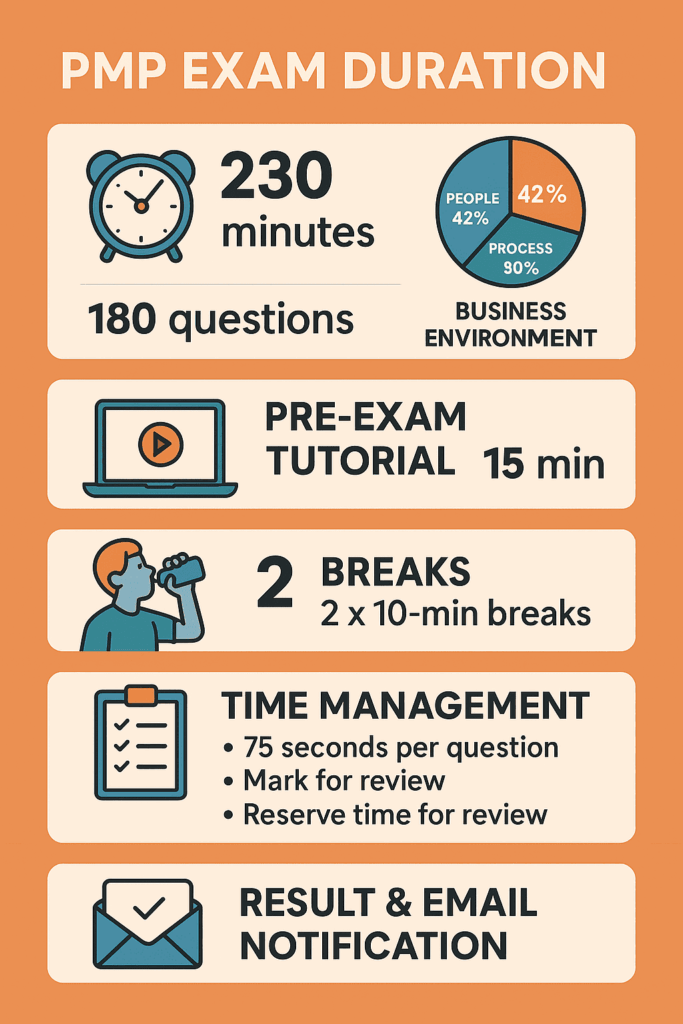
Quick Answer: The PMP exam duration is 230 minutes (3 hours 50 minutes), in which candidates answer 180 multiple-choice questions. Two scheduled 10-minute breaks, totaling 30 minutes, are provided and do not count against exam time. Knowing the full PMP exam timing, structure, and question count is crucial for exam-day pacing and success.
- Duration: 230 minutes to complete the exam
- Number of Questions: 180
- Scheduled Breaks: Two 10-minute breaks (not included in exam timing)
- Format: Computer-based, multiple-choice
- Set by: Project Management Institute (PMI)
How Long Is the PMP Exam Defined: Technical vs. Everyday Language
Formal Definition
The PMP exam is officially 230 minutes long, allotted for 180 questions. Candidates receive two 10-minute breaks, which are automatically provided after specified question milestones and are not included in the timed exam period. The exam’s duration and structure are governed by the Project Management Institute (PMI), aligning with best practices in professional exam standards.
Simple Analogy
Think of the PMP exam as a marathon with three segments: running (answering exam questions), water stations (scheduled breaks), and the final sprint. While you must stay on schedule, you can pause for short “water breaks” after key milestones, letting you recharge before continuing.
Origin and History
Established in 1984, the PMP certification by PMI standardized project management credentials globally. With evolving industry needs, the exam’s length and structure have adjusted over decades to better reflect modern project demands. The current 230-minute, break-inclusive design balances thoroughness with test-taker stamina, as corroborated by PMI.
How PMP Exam Timing Works
Exam-Day Process
- Register and schedule your PMP exam through PMI and an authorized testing partner.
- On exam day, begin the computer-based exam, managed by secure timer software.
- Answer questions 1–60.
- Take the first mandatory 10-minute break (break time is not deducted from the exam clock).
- Continue with questions 61–120.
- Take the second 10-minute break.
- Finish questions 121–180.
- Submit the exam for results processing.
Key Components
- Candidate: Test taker
- Project Management Institute (PMI): Certifying authority
- Testing Center/Online Proctor: Exam administration
- Exam Questions: 180 multiple-choice based on the PMBOK and Agile Practice Guide
- Timer and Break Management Software: Enforce timing and pauses
The 3 Main Types of PMP Exam Timing
Type 1: Standard-Paced Exam
Most candidates use the full 230 minutes and both breaks. This pace suits those who want balanced focus and review time—roughly 1.3 minutes per question.
Type 2: Accelerated Exam Pace
Highly prepared candidates may answer quickly—around 1 minute per question—finishing early and reserving extra time for review, reducing stress if they encounter difficult items.
Type 3: Slow-Paced Exam with Frequent Pauses
Some prefer working more slowly (up to 2 minutes per question at the start), making full use of structured breaks and thorough section reviews before moving on.
| Type | Total Duration | Breaks Included | Question Pace | Best For |
|---|---|---|---|---|
| Standard-Paced Exam | 230 minutes | 2 x 10 minutes | ~1.3 minutes per question | Balanced test takers |
| Accelerated Pace | 230 minutes | 2 x 10 minutes | ~1 minute per question | Confident, fast candidates |
| Slow-Paced Exam | 230 minutes | 2 x 10 minutes | Up to 2 minutes per question | Detail-oriented, cautious test takers |
Real-World Applications and Examples
Industry Applications
- IT & Software Development: PMP-certified professionals leverage exam pacing akin to agile sprint cycles, treating question blocks and breaks like work intervals and rest periods to maintain focus.
- Construction Project Management: Time management skills honed from PMP exam strategies improve actual project pacing and milestone tracking.
Personal Preparation Example
Individual candidates regularly simulate full-length mock tests with identical 230-minute timing and scheduled breaks, leading to greater exam-day confidence and accuracy.
Before/After Scenario
| Before Timing Awareness | After Timing Awareness |
|---|---|
| Rushed, incomplete answers; increased anxiety | Strategic pacing, full use of breaks, higher pass rates |
Benefits of Knowing PMP Exam Timing
- Structured Timing Enhances Focus: Awareness of exam flow improves concentration and reduces error rates.
- Scheduled Breaks Promote Mental Refreshing: Two planned breaks fight fatigue, as supported by testing best practices and the Project Management Institute (PMI).
- Predictable Question Count Enables Strategic Pacing: Knowing you face 180 questions helps you pace yourself and plan review periods.
Limitations and Criticisms
- Strict Timing May Pressure Some Candidates: 230 minutes can feel rushed for those needing extra time on complex items.
- Fixed Breaks Lack Flexibility: Both 10-minute breaks are mandatory and can only be taken after specific question sets, which may not suit everyone’s needs.
Common Misconceptions
- Misconception: The PMP exam lasts exactly 4 hours, no breaks.
- Fact: It is 230 minutes, plus two scheduled 10-minute breaks (total exam session length is about 4 hours, but only 3 hours 50 minutes are spent on questions).
PMP Exam vs. CAPM Exam: Key Differences
| Feature | PMP Exam | CAPM Exam |
|---|---|---|
| Duration | 230 minutes | 180 minutes |
| Number of Questions | 180 | 150 |
| Scheduled Breaks | 2 x 10 minutes | No scheduled breaks |
| Exam Fee (Typical) | $405–$555 | $225–$300 |
Which Certification Should You Choose?
Choose PMP if you have significant project management experience and want a globally recognized, advanced credential. Opt for CAPM if you’re newer to project management or need a foundational certification to get started.
The Future of PMP Exam Timing
Emerging Trends
PMI is studying adaptive testing, which may lead to flexible exam durations based on real-time performance. Expect potential updates in format—such as more agile-focused content or adjusted break scheduling—for the 2025–2026 exam cycles.
FAQ
How long is the PMP exam including breaks?
The total PMP exam session lasts about 4 hours, with 230 minutes dedicated to questions and two 10-minute breaks in between.
Can I skip or reschedule PMP exam breaks?
No. Breaks are compulsory, fixed, and cannot be skipped or moved.
How many questions are there on the PMP exam?
There are 180 multiple-choice questions.
How should I pace myself during the PMP exam?
Aim for roughly 1.3 minutes per question, using scheduled breaks to rest and review.
Is the PMP exam timing the same online and in-person?
Yes, both formats have identical timelines and breaks.
What if I finish the exam early?
You may review and change answers within the allotted time before submission.
Are longer breaks allowed?
No, only the two scheduled 10-minute breaks are permitted per PMI guidelines.
Learn More
- PMP Exam Preparation Tips for Timing Success
- Understanding PMP Exam Question Formats
- How to Schedule Your PMP Exam Day Efficiently
- Break Management Strategies for PMP Candidates
Further Reading & Resources
- Project Management Institute Official PMP Handbook
- PMI Exam Content Outline 2026
- Simplilearn PMP Exam Duration Guide
Ready to master your PMP exam timing? Follow our proven strategies for break management and time pacing to improve your performance and join the ranks of globally certified project managers. Start preparing today!