Define Agile: The Complete 2026 Guide for PMP Professionals
Quick Answer: Agile is an iterative approach to project management that emphasizes flexibility, collaboration, and customer feedback. The Agile Manifesto outlines four core values and twelve principles that guide Agile practices.
Define Agile: The Complete 2026 Guide
Agile is an iterative approach to project management that emphasizes flexibility, collaboration, and customer feedback. Originally developed for software development, Agile methodologies have since been adopted across industries to improve project outcomes.
What is Agile?
The Agile Manifesto, created in 2001, outlines four core values and twelve principles that guide Agile practices. Agile methodologies prioritize delivering value to customers through incremental, iterative work cadences known as sprints.
Core framework
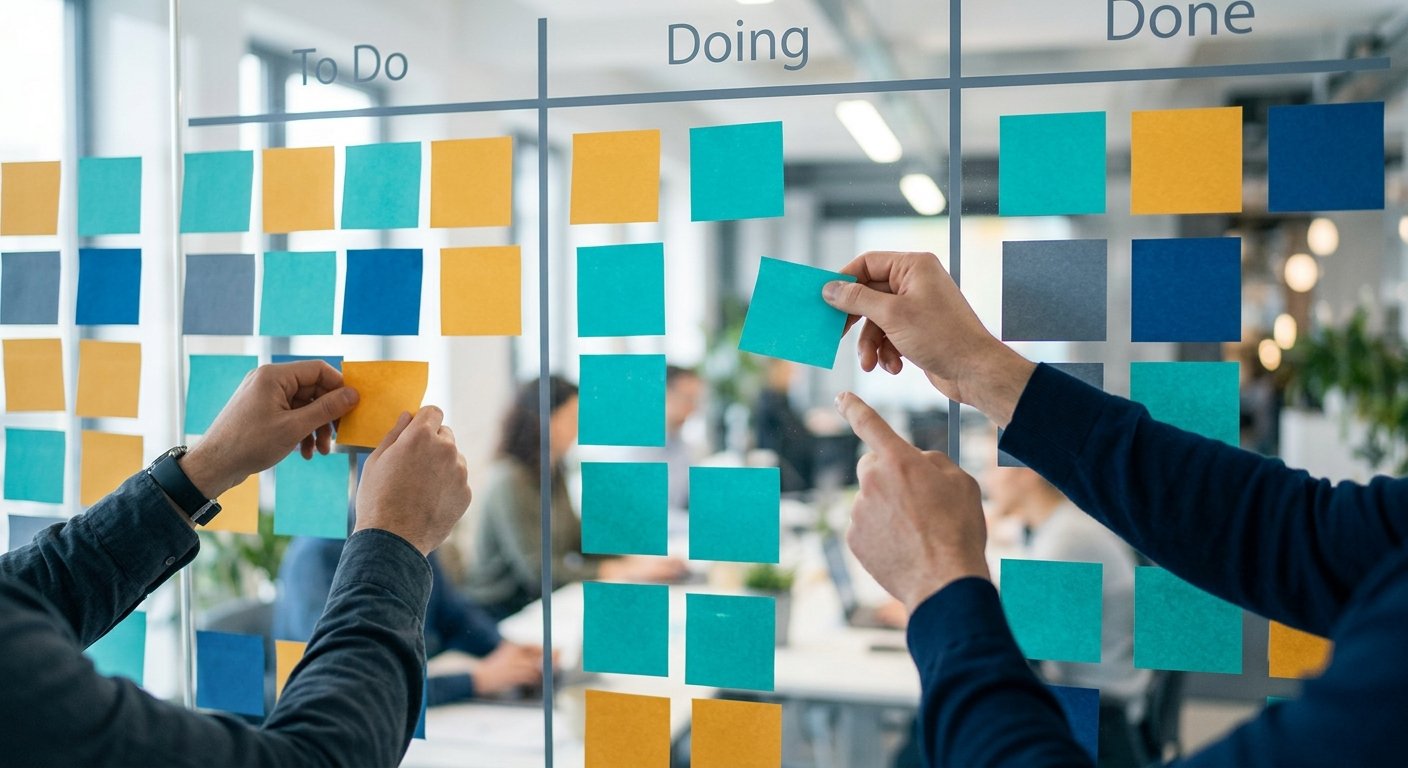
Scrum and Kanban are two of the most popular Agile frameworks:
- Scrum: Roles (Product Owner, Scrum Master, Development Team), Events (Sprint, Daily Standup, Sprint Review, Retrospective), Artifacts (Product Backlog, Sprint Backlog, Increment)
- Kanban: Visual workflow management, Work in Progress (WIP) limits, Continuous delivery
How Agile appears in the 2026 PMP exam
Approximately 60% of the 2026 PMP exam uses agile or hybrid approaches, distributed across all three domains. The Process domain (41% of the exam) carries the largest volume of agile-related questions.
When to choose pure Agile vs hybrid
Pure Agile works best when requirements are likely to change frequently. Hybrid approaches combine Agile with predictive methods when certain aspects of the project require more structure.
Common anti-patterns
- Treating Agile as a set of rituals rather than a mindset
- Ignoring technical debt in favor of speed
- Lack of true cross-functional teams
Metrics that matter
Key Agile metrics include velocity, cycle time, lead time, and cumulative flow diagrams. These help teams measure performance and identify improvement opportunities.
Related reading
Key Takeaways
- Agile is an iterative approach emphasizing flexibility and customer value.
- The 2026 PMP exam includes approximately 60% agile or hybrid content.
- Scrum and Kanban are the most common Agile frameworks.
- Hybrid approaches combine Agile with predictive methods when needed.
- Common anti-patterns include treating Agile as just rituals and ignoring technical debt.
Frequently Asked Questions
Q: What is the difference between Scrum and Kanban?
A: Scrum is an iterative framework with fixed-length sprints, while Kanban focuses on continuous flow with visual workflow management and WIP limits.
Q: When should I choose hybrid over pure agile?
A: Choose hybrid when parts of your project require predictive planning (like regulatory compliance) while other aspects benefit from agile flexibility.
Q: How much of the 2026 PMP exam is agile or hybrid?
A: Approximately 60% of the 2026 PMP exam uses agile or hybrid approaches, distributed across all three domains.
Q: What are common agile anti-patterns?
A: Common anti-patterns include treating agile as just rituals, ignoring technical debt, and lacking truly cross-functional teams.
Q: What are the four values of the Agile Manifesto?
A: The four values are: Individuals and interactions over processes and tools, Working software over comprehensive documentation, Customer collaboration over contract negotiation, Responding to change over following a plan.
Q: How does Agile appear in the PMP exam’s Business Environment domain?
A: Agile in Business Environment (26% of exam) typically appears in scenarios about organizational change, compliance in agile contexts, and value delivery measurement.