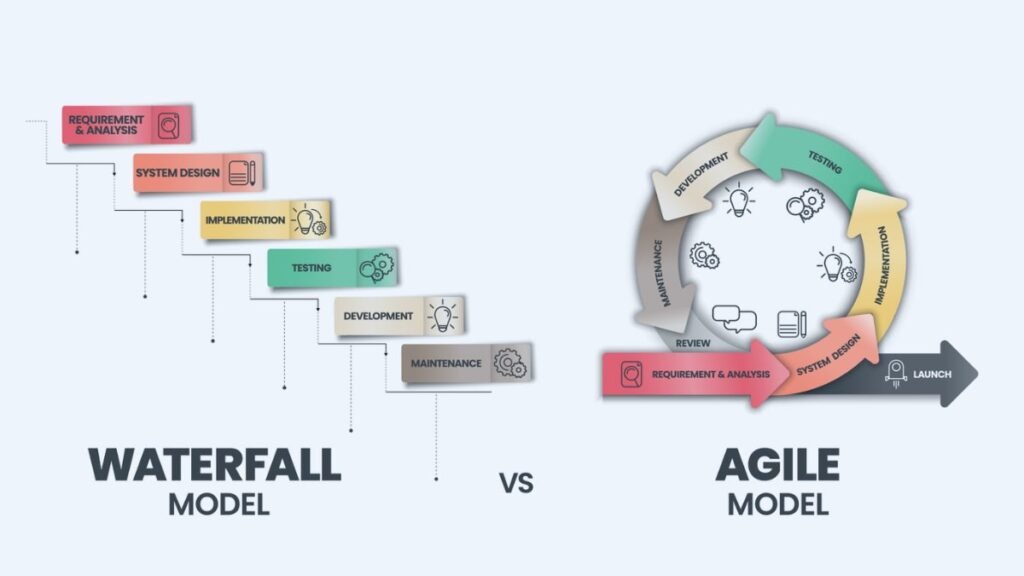
Waterfall is a linear, sequential project methodology where all planning happens upfront, phases are executed in order, and scope is fixed. Agile is an iterative, adaptive approach where work is done in short cycles (sprints), requirements evolve through collaboration, and the focus is on delivering value early and often. The core difference is flexibility vs. predictability.
Key Points:
- Planning: Waterfall requires extensive upfront planning; Agile plans adaptively in each cycle.
- Change: Waterfall resists change after start; Agile welcomes and incorporates change.
- Delivery: Waterfall delivers one final product at the end; Agile delivers working increments throughout.
- Best For: Waterfall excels in projects with fixed, clear requirements (e.g., construction). Agile excels in projects with uncertainty and evolving needs (e.g., software).
Table of Contents
The Foundational Choice for Project Success
Agile vs. Waterfall represents the fundamental philosophical choice in project management: predictability versus adaptability. According to the Project Management Institute’s 2026 Pulse of the Profession report, organizations that strategically match methodology to project type see 40% higher success rates. This guide delivers a comprehensive, actionable comparison—moving beyond theory—to provide the definitive framework for selecting the right approach based on your project’s unique requirements, stakeholder needs, and industry context. You will learn not just the definitions, but the mechanisms, trade-offs, and modern applications that empower you to make an informed, high-impact decision.
Choosing incorrectly isn’t an academic misstep; it risks budget overruns, missed market opportunities, and project failure. Let’s build your decision-making framework.
What is the Main Difference Between Agile and Waterfall?
Agile is an iterative, feedback-driven approach designed for adaptability, while Waterfall is a linear, phase-gated approach designed for predictability. The Agile Manifesto (2001) values “responding to change over following a plan,” whereas Waterfall, formalized by Winston Royce in 1970, is built on the principle of completing defined phases (Requirements, Design, Implementation, Testing, Deployment) in strict sequence, with minimal backtracking.
Bottom line: If your project’s requirements are stable and well-understood, Waterfall provides clarity. If requirements are volatile or discovery is part of the process, Agile provides resilience.
How Agile and Waterfall Work: Mechanism & Process Comparison
Process Flow Visualization: Linear vs. Cyclical
The 5 Core Distinguishing Factors
1. Requirements & Scope
- Waterfall: Fixed, defined in detail at the start in a requirements document. “Scope is king.”
- Agile: Dynamic, captured in a prioritized list (Product Backlog) and refined each cycle. “Value is king.”
2. Planning & Scheduling
- Waterfall: Single, comprehensive plan upfront (e.g., Gantt chart). The entire project timeline is mapped.
- Agile: Rolling-wave planning. High-level roadmap with detailed planning only for the upcoming 2-4 week sprint.
3. Phases & Iterations
- Waterfall: Sequential phases. A phase gate review must be passed to proceed. Cannot move back easily.
- Agile: Time-boxed iterations (Sprints). Each sprint includes all work to produce a potentially shippable increment.
4. Change Management
- Waterfall: Change is expensive, requires formal change control procedures, and often impacts timeline/cost significantly.
- Agile: Change is expected and can be incorporated at the start of the next sprint with minimal disruption, as the plan is short-term.
5. Measurement of Progress
- Waterfall: Progress is measured by completion of phases and tasks against the baseline plan (% complete).
- Agile: Progress is measured by working features delivered and validated by the customer (value delivered).
Agile vs Waterfall: Decision Matrix & Best Applications
This table synthesizes research and expert consensus to guide your methodology selection.
| Project Characteristic | Waterfall is Typically Better | Agile is Typically Better | Hybrid Approach May Be Best |
|---|---|---|---|
| Requirements Clarity | Stable, clear, and fixed. Defined by regulation or contract. | Unclear, evolving, or unknown. Discovery is needed. | Mix of stable and evolving elements. (e.g., fixed hardware, agile software) |
| Project Size & Complexity | Large, but complexity is understood. Interfaces are well-defined. | Any size, but especially valuable for complex, innovative work. | Large-scale projects requiring high-level predictability with adaptive execution. |
| Flexibility for Change | Low change tolerance. Changes are costly/forbidden after start. | High change tolerance/expectation. Market feedback is crucial. | Moderate. Some phases are fixed (compliance), others are flexible (UI design). |
| Customer Involvement | Primarily at start (requirements) and end (delivery). | Continuous collaboration and feedback required. | Periodic reviews at major milestones, with focused collaboration during adaptive phases. |
| Risk Profile | High risk of late-stage failure if requirements were wrong. | Risk is identified and mitigated early through incremental delivery. | Risks are segmented; predictable risks handled upfront, uncertain risks handled iteratively. |
| Industry Examples | Construction, Manufacturing, Aerospace (regulatory, physical). | Software, IT, Digital Marketing, Startups (volatile, innovative). | Pharma, Automotive, Finance (blend of regulatory and innovative components). |
| Contract Type | Fixed-Price, Fixed-Scope. | Time & Materials or Value-Based. | Phased contracts: Fixed for initial scope, Agile for later enhancements. |
Multiple Perspectives Summary: While purists argue for methodological purity, the 2026 pragmatic consensus is that hybrid approaches dominate complex project landscapes. The skill lies in consciously designing the blend, not defaulting to one extreme.
Common Questions Answered
Q: Which methodology has a higher success rate?
A: Success is project-dependent. The 2025 Standish Group Chaos Report indicates that for software projects with clearly defined goals, Agile projects show a significantly higher success rate (42%) compared to Waterfall (26%). However, for well-understood, repeatable projects, Waterfall’s success rate is comparable. The key is fit-for-purpose selection.
Q: Is Agile faster than Waterfall?
A: Agile delivers value faster, but not necessarily the final product faster. Agile’s iterative cycles produce working features early (e.g., an MVP in 3 months), enabling early ROI. Waterfront may deliver the complete product in 12 months. Agile’s speed is in learning and time-to-market; Waterfall’s is in predictable execution of a known plan.
Q: Can you use Agile for construction or hardware?
A: Pure Agile is challenging, but Agile principles (iterative design, stakeholder feedback) are increasingly applied in “Agile Hardware” and Lean Construction. These fields use iterative prototyping and frequent reviews within an overall predictive framework to manage physical constraints.
Q: What is the role of the project manager in each?
A: In Waterfall, the Project Manager is the central controller—planning, assigning, tracking. In Agile frameworks like Scrum, this role splits: the Product Owner manages the ‘what’ (backlog), the Scrum Master facilitates the ‘how’ (process), and the self-organizing Team manages execution. The PM often becomes an Agile Coach or Hybrid PM overseeing the blend.
Q: Is Scrum the same as Agile?
A: No. Agile is the philosophy (the what), defined by values and principles. Scrum is a specific, popular framework for implementing Agile (the how), with defined roles (PO, SM), events (Sprint, Daily Scrum), and artifacts (Backlog, Increment). Other frameworks include Kanban and XP.
Pro Tips, Pitfalls, and Modern Implementation
Efficiency Hacks from Practitioners (Based on 15+ Years Experience)
- The Hybrid Pilot Hack: For organizations new to Agile, run a pilot project using a hybrid model. Use Waterfall for governance/budgeting and Agile (Scrum) for a 3-month development phase. This builds comfort and demonstrates value.
- The Contract Hack: For fixed-budget projects where Agile is needed, use a “Fixed-Price, Variable-Scope” or “Target Cost” contract. Define a prioritized backlog, agree that the team will deliver the highest possible value within the budget and time, and adjust scope accordingly.
- The Documentation Hack: Agile’s “working software over documentation” is often misapplied. Document key decisions, architecture, and compliance evidence just-in-time and in a lightweight format (wikis, diagrams). This satisfies audit needs without Waterfall’s overhead.
Common Pitfalls and How to Avoid Them
- Pitfall: Using Waterfall for an innovative product. This leads to building the wrong thing. Avoid: If requirements are uncertain, start with at least a discovery phase using Agile techniques (user stories, prototyping).
- Pitfall: Using Agile in a rigid, compliance-heavy environment without adaptation. This leads to audit failures. Avoid: Implement a hybrid. Use Waterfall’s rigor for mandatory phases (e.g., FDA submission) and Agile’s flexibility for adjacent work (e.g., supporting software).
- Pitfall: Believing the choice is permanent. Avoid: Conduct a project kickoff methodology workshop. Assess the project against the decision matrix with stakeholders. Choose consciously, and plan to reassess at major milestones.
Your Actionable Decision Framework
In summary, the Agile vs. Waterfall debate is resolved by a clear-eyed assessment of your project’s nature. Waterfall provides control and predictability for the known. Agile provides flexibility and customer alignment for the unknown. The modern project leader’s toolkit must include competence in both, and the wisdom to blend them into a coherent, effective hybrid approach.
Final Synthesis: Research suggests that the most successful organizations are methodology-agnostic. They train their teams in both philosophies and empower them to select and tailor the approach based on a project’s specific requirements stability, team location, stakeholder engagement level, and risk profile.
Ready to choose for your next project? Use our Interactive Agile-Waterfall Decision Matrix Tool to get a data-backed recommendation in minutes.
Your Next Steps:
- If Agile fits: Deep dive into implementing Scrum.
- If Waterfall fits: Master the phase-gate process.
- If Hybrid fits: Learn to design a custom hybrid approach.

Leave a Reply