
Foundational Overview: What is a Project Manager and Why It Matters
A project manager is the strategic linchpin who transforms vision into reality. They are the organized, communicative leaders responsible for planning, executing, and closing projects—temporary endeavors with specific goals, scope, and resources. In an economy defined by change and innovation, the role of a project manager is more critical than ever, serving as the bridge between strategic objectives and tangible results. This pillar guide provides the definitive roadmap on how to become a project manager, from foundational skills to long-term career mastery.
Table of Contents
The Core Definition and Scope
The project manager is accountable for the project’s success. Their core mandate is to deliver the project’s objectives on time, within budget, and to the required quality standards, while managing stakeholder expectations. The scope of the role is universal, applying to industries as diverse as software development, construction, healthcare, marketing, and finance. At its heart, it’s a role of leadership, coordination, and problem-solving.
Historical Context and Evolution [UPDATE: 2026]
Historically, project management was an informal skill practiced by engineers and military leaders. It professionalized in the mid-20th century with the development of formal methodologies like CPM and PERT. The establishment of PMI in 1969 and the creation of the PMP certification marked a major evolution. Today, the role has transformed from a process-focused administrator to a versatile leader who must master Agile and hybrid methodologies, emotional intelligence, and business strategy. In 2026, the project manager is a value-driven change agent, not just a scheduler.
The “Magic Triangle”: Interconnected Principles That Govern Success
Project management success is governed by the interconnected “Triple Constraint” or “Iron Triangle”:
- Scope: The work that needs to be done.
- Time: The schedule for completion.
- Cost: The budget allocated.
A change in one invariably affects the others. Balancing these constraints while maintaining Quality (often depicted at the triangle’s center) is the project manager’s primary challenge and the core principle of the profession.
The Complete Classification System
Primary Types and Models
Project managers often specialize. Technical Project Managers lead software and IT projects. Construction Project Managers oversee physical builds. General/Business Project Managers handle internal initiatives like process improvement or marketing campaigns. The core skills overlap, but the domain knowledge differs.
Scale Variations: From Residential to Commercial Applications
- Entry-Level/Coordinator (“Residential”): Manages small, internal projects or supports a senior PM. Focuses on administrative tasks, tracking, and communication.
- Mid-Level/Project Manager (“Commercial”): Leads standalone projects with defined teams and budgets. Full accountability for the triple constraint.
- Senior-Level/Program/Portfolio Manager (“Enterprise”): Manages a group of related projects (Program) or a portfolio of projects aligned with organizational strategy. Focus is on benefits realization and strategic alignment.
Regional/Climate-Based Adaptations
Demand and specialization vary by region. Tech hubs (Silicon Valley, Bangalore) have high demand for Agile/Technical PMs. Areas with major infrastructure have demand for Construction PMs. Remote work has also created a global market for digital project management roles.
The End-to-End Lifecycle Framework
Phase 1: Initiation and Planning (Career Foundation)
This is your career initiation. Define your goal to become a PM. Plan your path: research required education (degree, certificates), skills, and entry points. The deliverable is a personalized career development plan.
Phase 2: Implementation and Execution (Skill Acquisition & First Role)
Execute your plan. Gain foundational knowledge through courses or a CAPM certification. Develop skills through volunteer work, internships, or lateral moves in your current job (e.g., leading a small initiative). Land your first official project coordinator or junior PM role.
Phase 3: Operation and Maintenance (Professional Growth)
You are now a practicing PM. Operate by successfully delivering projects. Maintain and grow your career by earning a senior-level certification (PMP), building a professional network, and seeking increasingly complex projects.
Phase 4: Optimization and Scaling (Career Advancement)
Optimize your value. Move into program or portfolio management, specialize (e.g., Agile Coach, Risk Manager), or move into consultancy. Mentor others. Your focus scales from single-project success to organizational impact.
Phase 5: Renewal or Replacement (Continuous Reinvention)
The field evolves. You must renew your skills by learning new methodologies (e.g., AI in PM), earning PDUs, and staying current. The alternative is career stagnation or replacement by those with more current skills.
Key Stakeholders and Ecosystem Dynamics
Roles and Responsibilities Matrix
- Project Manager: Leads the team, manages the plan, communicates with stakeholders, and is accountable for delivery.
- Project Sponsor: Senior executive who champions the project, provides resources, and makes high-level decisions.
- Project Team: Cross-functional specialists who perform the project work.
- Stakeholders: Anyone affected by the project (clients, end-users, departments). The PM must manage their expectations and engagement.
- Functional Managers: Department heads who provide team members and resources.
Communication Protocols and Documentation Standards
- Communication Plan: A core document outlining who needs what information, when, and how.
- Status Reports: Regular updates on progress, risks, and issues.
- Project Charter & Plan: Authorizing and defining the project’s baseline.
- Modern Protocols: Heavy use of collaboration tools (Slack, Teams), video conferencing, and shared online documents (Google Workspace, Confluence).
Regulatory and Compliance Landscape
In regulated industries (pharma, finance, government), PMs must navigate specific compliance frameworks (GxP, SOX, GDPR). Documentation, audit trails, and formal change control are critical. Professional certifications like the PMP demonstrate a standardized approach valued in these environments.
Tools, Technology, and Performance Management
Essential Tools and Software Solutions
- Scheduling & Planning: Microsoft Project, Smartsheet, or Asana for Gantt charts and timelines.
- Collaboration & Work Management: Jira (for Agile/tech), Trello, Monday.com for task tracking and team coordination.
- Communication: Slack, Microsoft Teams for daily interaction.
- Document Management: Confluence, SharePoint, Google Drive..
Key Performance Indicators (KPIs) and Metrics Dashboard
Measure success with a balanced dashboard:
- Schedule Performance: Schedule Variance (SV), On-Time Completion %.
- Cost Performance: Cost Variance (CV), Budget Adherence.
- Quality: Defect Rate, Customer Satisfaction (CSAT) scores.
- Stakeholder & Team Health: Stakeholder Engagement scores, Team Velocity (Agile), Employee Net Promoter Score (eNPS).
Data-Driven Decision Making Framework
Modern PMs use data to steer projects:
- Collect: Gather real-time data from project tools (progress, costs, risks).
- Analyze: Compare actuals to the plan (earned value analysis), forecast trends.
- Decide: Make informed decisions on course corrections, resource reallocation, or scope adjustments.
- Act: Implement decisions and monitor outcomes.
Comparative Analysis and Strategic Decision Matrix
Side-by-Side Comparison Table
| Option | Best For Scenario | Advantages | Limitations | Cost Range (Career Entry) | Skill Required |
|---|---|---|---|---|---|
| Formal Degree Path | Recent high school grads, career changers wanting a structured foundation. | Comprehensive education, strong theoretical base, qualifies for many corporate roles. | Time-consuming (4 years), expensive, less practical experience. | $40,000 – $100,000+ | Academic discipline, time management. |
| Certification & Experience Path | Professionals already in the workforce (e.g., engineers, analysts) looking to transition. | Faster, cheaper, focuses on practical application, leverages existing domain knowledge. | Requires self-motivation, need to find a way to gain initial project experience. | $1,000 – $5,000 (for certs & courses) | Self-study, networking, proactive skill-seeking. |
| Internal Promotion Path | Employees at a company who can demonstrate PM skills on internal initiatives. | Low risk, uses existing company knowledge, employer may sponsor training. | Dependent on company opportunity, may be slower, scope may be limited. | $0 – $2,000 (possible employer-paid training) | Initiative, internal networking, proving competence. |
Risk Assessment and Mitigation Strategies
- Risk: Entering the field with no practical experience (“No experience, can’t get a job” loop).
- Mitigation: Gain experience through volunteer work (non-profits), freelancing on small gigs, or managing projects in your current non-PM role.
- Risk: Rapid methodology changes (e.g., shift to Agile) making skills obsolete.
- Mitigation: Commit to continuous learning. Pursue certifications (PMI-ACP), take courses, and stay engaged with professional communities.
- Risk: Burnout from high stress and constant multitasking.
- Mitigation: Develop strong boundaries, master delegation, utilize productivity tools, and prioritize work-life balance.
Future Trends and Innovations [UPDATE: 2026]
The project manager’s role will be augmented by AI and automation for scheduling, risk prediction, and reporting, freeing up time for strategic leadership. Data literacy will become a core skill. Hybrid project management (blending Agile, predictive, and design thinking) will be the standard. Emotional intelligence and change leadership will differentiate top performers from task managers.
Implementation Roadmap and Resources
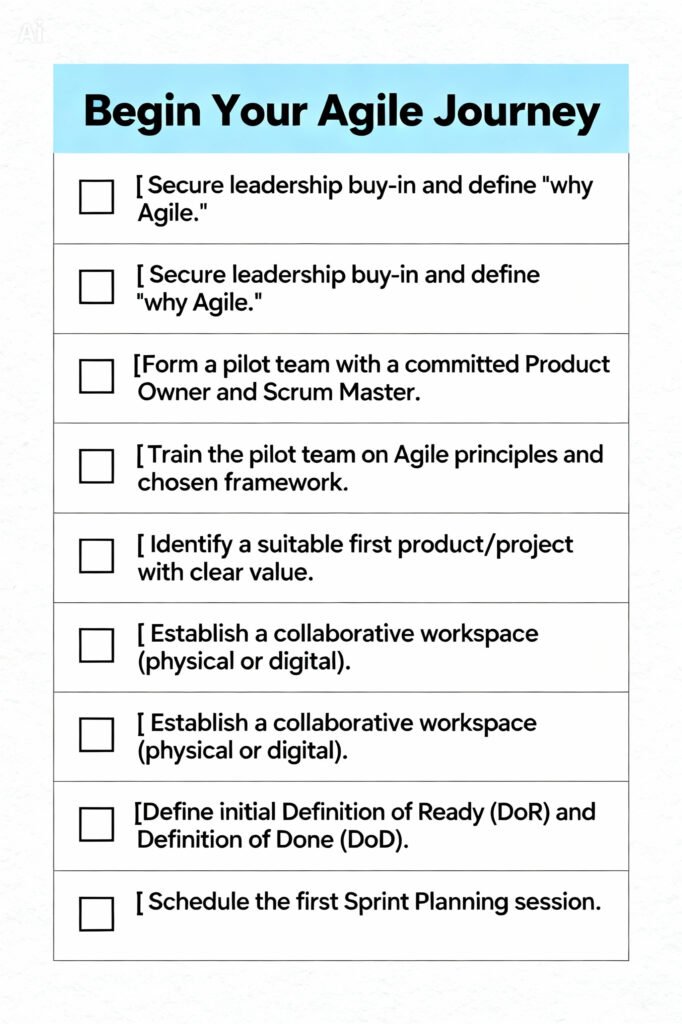
Actionable Checklist for Getting Started
Common Pitfalls and How to Avoid Them
- Pitfall: Assuming you need to be an expert in everything.
- Avoid: Your role is to be an expert in managing experts. Focus on leadership and process, not deep technical mastery in all areas.
- Pitfall: Neglecting “soft skills” like stakeholder management and negotiation.
- Avoid: Actively develop these skills through books, courses, and practice. They are often more important than technical PM skills.
- Pitfall: Getting the first PM job and stopping your education.
- Avoid: The PMP certification should be a mid-career goal, not the end. Continue learning about leadership, business, and new methodologies.
Recommended Next Steps Based on Your Goals
- “I have zero experience. Where do I start?” → Read our guide to entry-level project management roles and the CAPM.
- “I’m ready to earn my PMP.” → Follow our complete PMP certification guide.
- “I want to specialize in Agile.” → Explore our pillar guide to Agile Methodology.“How do I negotiate a higher PM salary?” → See our PMP salary and negotiation guide.
Reference Section
Key Takeaways and Summary
- Becoming a project manager is a strategic career path requiring a blend of education, skill development, and practical experience.
- There are multiple entry paths: formal degree, certification/transition, or internal promotion. The certification path (CAPM -> PMP) is highly effective for career changers.
- Core competencies extend beyond scheduling to include leadership, communication, stakeholder management, and business acumen.
- The profession is evolving with technology; future PMs must be agile, data-literate, and exceptional leaders of people and change.
- Long-term success requires continuous learning, networking, and a commitment to delivering value.
Complete Glossary of Terms
- Project: A temporary endeavor undertaken to create a unique product, service, or result.
- Stakeholder: Any individual, group, or organization that may affect, be affected by, or perceive itself to be affected by a decision or activity of the project.
- Scope: The sum of all products, services, and results to be provided as a project.
- Agile: An iterative approach to project management that focuses on delivering value in small increments and adapting to change.
- Waterfall/Predictive: A sequential, linear project management approach where each phase must be completed before the next begins.
- PMP: Project Management Professional, the premier global certification for project managers.
- CAPM: Certified Associate in Project Management, an entry-level certification from PMI.
- Gantt Chart: A bar chart that illustrates a project schedule, showing task durations and dependencies.
Frequently Asked Questions
Q: Do I need a degree to become a project manager?
A: Not necessarily. While many job postings request a bachelor’s degree, a strong combination of certifications (CAPM/PMP), proven experience, and demonstrable skills can be equally or more valuable, especially in tech and startups.
Q: What is the best project management certification for beginners?
A: The Certified Associate in Project Management (CAPM) from PMI is specifically designed for those with little to no formal project management experience. It teaches the fundamental language and processes of the profession.
Q: What is the average entry-level project manager salary?
A: In 2026, entry-level salaries vary widely by location and industry but typically range from $55,000 to $75,000 in the United States. With a PMP and experience, this can rise to a median of $110,000 – $130,000+.
Q: Can I become a project manager with no experience?
A: You can’t become a project manager with no experience, but you can become qualified. Gain relevant experience by managing tasks in your current role, volunteering, or starting in a project coordinator/assistant role.
Q: What are the most important skills for a project manager?
A: Beyond organization, the top skills are communication, leadership, stakeholder management, problem-solving, and adaptability. Technical tools can be learned; these soft skills are critical.
Q: Is project management a stressful job?
A: It can be, as you are often the central point for problems, deadlines, and conflicting priorities. However, strong processes, delegation skills, and boundary-setting can manage the stress effectively.
Q: What’s the difference between a project manager and a product manager?
A: A Project Manager focuses on the execution of a project (how, when, cost). A Product Manager focuses on the strategy and vision of a product (what, why, for whom). Their work is complementary.
Q: How important is networking for a PM career?
A: Extremely important. Many PM jobs are found through referrals and professional networks (like PMI chapters). Networking is also crucial for learning, mentorship, and career advancement.
Further Reading and Authoritative Sources
- Project Management Institute (PMI) Earning Power Salary Survey: Authoritative data on PM salaries by region, industry, and certification.
- PMI’s Pulse of the Profession: Annual report on global project management trends, success rates, and the value of the profession.
- U.S. Bureau of Labor Statistics – Project Management Specialists: Government data on job outlook, median pay, and typical entry-level education.
The path to leadership starts with a single step. Start your PM career today with our free career path assessment and personalized resource toolkit.
External Resources:
- Project Management Institute (PMI) Careers Page: Official resource on PM careers, certifications, and the value of the profession. (https://www.pmi.org/about/careers)
- LinkedIn Learning – Project Management Path: A structured collection of courses for building PM skills from the ground up. (https://www.linkedin.com/learning/paths/become-a-project-manager)
- The Ladders / Indeed Salary Tool: For researching real-time salary data for project management roles in your specific location.

Leave a Reply