
What is PMP Certification and Why It Matters
The Project Management Professional (PMP)® certification is the globally recognized gold standard for project managers. Awarded by the Project Management Institute (PMI), it validates an individual’s competency in leading and directing projects across the domains of People, Process, and Business Environment. This PMP certification guide provides the comprehensive roadmap you need, from initial consideration to career transformation.
Table of Contents
The Core Definition and Scope
The PMP is more than a credential; it’s a professional validation. It demonstrates that you possess the experience, education, and competency to successfully lead projects. Its scope is universal, applicable to project managers in virtually every industry—from IT and construction to healthcare and finance—making it the most versatile project management certification in the world.
Historical Context and Evolution [UPDATE: 2026]
Since its inception, the PMP has evolved from a process-centric certification based on the PMBOK® Guide to a performance-based assessment of a project manager’s ability to navigate complex scenarios. The most significant shift occurred with the 2021 exam update, which rebalanced content to reflect the modern workplace, with approximately 50% of the exam focused on Agile and hybrid approaches. In 2026, this evolution continues, emphasizing strategic influence, business acumen, and the project manager’s role as a true leader, not just an executor.
The “Magic Triangle”: Interconnected Principles That Govern Success
PMP success is governed by an interconnected triangle of principles:
- Proven Experience: The foundation, ensuring you have the practical background to apply concepts.
- Formal Education & Study: The framework, providing the standardized knowledge and “PMP mindset.”
- Practical Application: The culmination, where you use the credential to deliver better project outcomes, advance your career, and increase your earnings. All three must be in balance.
The Complete Classification System
Primary Types and Models
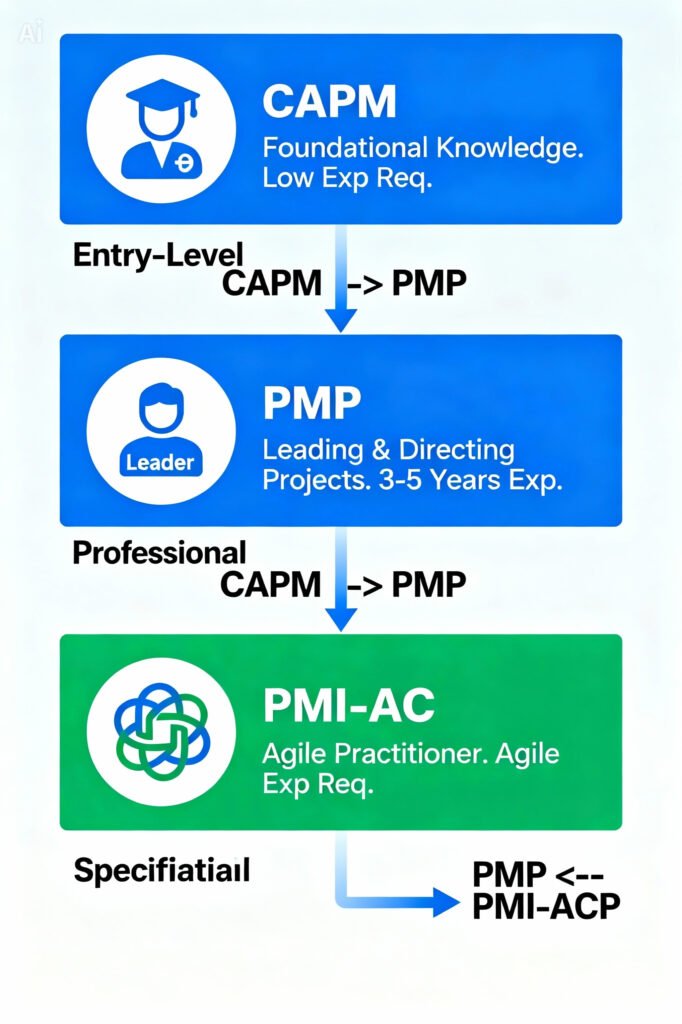
While the PMP is the flagship, it exists within PMI’s ecosystem. The Certified Associate in Project Management (CAPM)® is for those entering the field. The PMI Agile Certified Practitioner (PMI-ACP)® is for professionals specializing in Agile. The PMP is the comprehensive, experience-based credential for project leaders.
Scale Variations: From Residential to Commercial Applications
The PMP framework scales to any project size:
- Small-Scale (“Residential”): Managing departmental projects, process improvements, or small product launches. The principles of initiation, planning, and stakeholder engagement still apply.
- Large-Scale (“Commercial”): Leading enterprise-wide transformations, multi-million-dollar constructions, or global software implementations. Here, the PMP’s emphasis on risk, integration, and strategic alignment becomes critical.
Regional/Climate-Based Adaptations
While the credential is global, its application adapts. A PMP in a regulated industry (e.g., German manufacturing) will emphasize predictive processes and compliance. A PMP in a dynamic market (e.g., Southeast Asian tech) will leverage more Agile and hybrid approaches. Understanding these regional nuances can optimize your study and application approach.
The End-to-End Lifecycle Framework
Phase 1: Initiation and Planning
This phase involves assessing your eligibility, gathering documentation (projects, education proof), and creating a study plan and budget. The key deliverable is a committed decision to pursue the certification and a completed PMI application.
Phase 2: Implementation and Execution
The core work: studying the materials, taking practice exams, and internalizing the PMP mindset. This phase consumes the most time (150-200 hours) and focuses on knowledge acquisition and exam readiness.
Phase 3: Operation and Maintenance
You have passed the exam. Now you operate as a certified professional, applying the principles in your work. You also begin the 3-year maintenance cycle, earning 60 Professional Development Units (PDUs) to keep the credential active.
Phase 4: Optimization and Scaling
Leverage your PMP for career advancement: seeking promotions, higher salaries, or more complex projects. You may also add complementary certifications (like PMI-ACP or PMI-RMP) to specialize and scale your expertise.
Phase 5: Renewal or Replacement
Every three years, you renew your certification by completing the PDU requirements and paying the fee. The alternative—replacement—is allowing it to lapse, which requires retaking the exam to reinstate, a costly and unnecessary step.
Key Stakeholders and Ecosystem Dynamics
Roles and Responsibilities Matrix
- The Candidate: Responsible for meeting requirements, studying, and ethical conduct.
- PMI (Project Management Institute): The governing body that sets standards, administers the exam, and grants the credential.
- Employer/Sponsor: May provide financial support, time, and verification of experience.
- Training Providers: Offer courses and materials to prepare candidates.
- Verifiers: Past supervisors or colleagues who confirm your project experience if audited.
Communication Protocols and Documentation Standards
- Application: Must be clear, accurate, and honest. Use action verbs and quantify achievements.
- Audit Documentation: Requires formal, signed verification forms and official certificates.
- Professional Conduct: Adherence to PMI’s Code of Ethics and Professional Conduct is mandatory.
Regulatory and Compliance Landscape
The PMP itself is not a government license, but it is often required or highly preferred for project management roles in regulated industries (defense, pharmaceuticals, government contracting). It demonstrates a commitment to a standardized, professional practice. For official policies, always refer to PMI’s Certification Handbook.
Tools, Technology, and Performance Management
Essential Tools and Software Solutions
- Study Platforms: Comprehensive PMP prep courses with video libraries and question banks are the primary tool for most candidates. (e.g., Udemy).
- Exam Simulators: Standalone applications that replicate the testing environment are critical for building endurance and identifying weak areas.
- PDU Tracking Tools: PMI’s CCRS system is essential, but supplemental spreadsheets or apps can help plan and track continuing education.
Key Performance Indicators (KPIs) and Metrics Dashboard
Measure your certification journey:
- Study KPIs: Hours studied per week, practice exam scores (target: consistent >80%), domain proficiency scores.
- Career KPIs: Post-certification salary increase, promotion timeline, project success rate improvements.
- Maintenance KPI: PDUs earned vs. 3-year target (20/year is a safe pace).
Data-Driven Decision Making Framework
Use data to guide your process:
- Diagnostic: Take a baseline practice exam to identify knowledge gaps.
- Plan: Allocate more study time to weak domains.
- Execute: Study and take targeted quizzes.
- Monitor: Track practice scores to gauge improvement.
- Act: Adjust study tactics based on results before the actual exam.
Comparative Analysis and Strategic Decision Matrix
Side-by-Side Comparison Table
| Option | Best For Scenario | Advantages | Limitations | Cost Range | Skill Required |
|---|---|---|---|---|---|
| PMP Certification | Experienced project leaders seeking max recognition, salary boost, and career advancement. | Global gold standard, highest salary premium, versatile across industries. | Stringent experience requirements (3-5 years), significant study time (150-200 hrs). | $1,000 – $2,500 (all-in) | Project leadership, strategic thinking, exam technique. |
| CAPM Certification | Those new to project management, career changers, or team members needing foundational credibility. | Lower barrier to entry, establishes foundational knowledge, good resume builder. | Lower recognition and salary impact than PMP, not a substitute for experience. | $600 – $1,200 (all-in) | Basic project understanding, study discipline. |
| Self-Study & Experience | Individuals in industries where experience and portfolio outweigh credentials. | No direct financial cost, learn at own pace. | Lack of third-party validation, may miss structured knowledge, can hinder job applications. | $0 – $500 (for books) | Exceptional self-discipline, networking ability. |
Risk Assessment and Mitigation Strategies
- Risk: Failing the exam ($275+ retake fee, delay).
- Mitigation: Invest in high-quality prep materials and dedicate sufficient study time. Don’t schedule the exam until consistently scoring >80% on full simulators.
- Risk: Application audit (time stress).
- Mitigation: Document everything meticulously from the start. Assume you will be audited.
- Risk: Certification lapse (loss of credential).
- Mitigation: Set calendar reminders for PDU deadlines and renew early.
Future Trends and Innovations [UPDATE: 2026]
The PMP will continue to integrate data analytics, AI-assisted project management tools, and a stronger emphasis on emotional intelligence and change leadership. The hybrid model is now the baseline expectation, not an exception. Continuous learning via micro-credentials and digital badges may complement the core PMP credential.
Implementation Roadmap and Resources
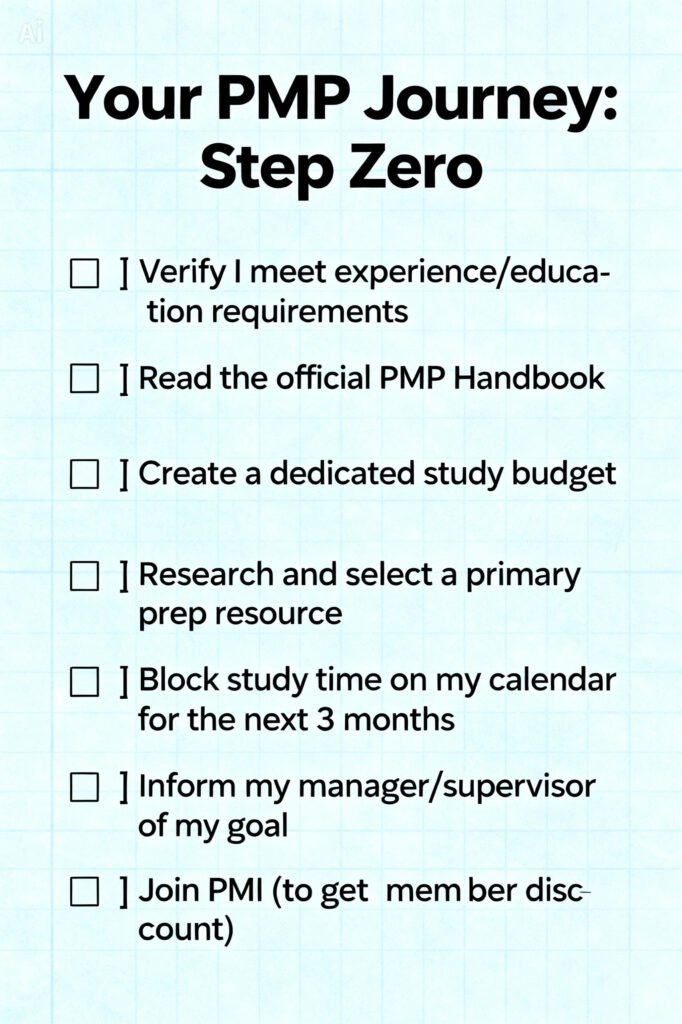
Actionable Checklist for Getting Started
Common Pitfalls and How to Avoid Them
- Pitfall: Underestimating the experience requirement.
- Avoid: Use PMI’s online application to draft your experience before you start studying to ensure you qualify.
- Pitfall: Relying solely on experience without studying the “PMP mindset.”
- Avoid: Recognize the exam tests how PMI believes a perfect project manager should act, which may differ from your workplace.
- Pitfall: Cramming at the end.
- Avoid: Follow a structured study plan from day one.
Recommended Next Steps Based on Your Goals
- “I need to check my eligibility.” → Read our detailed PMP requirements guide.
- “I’m ready to study.” → Choose from our reviewed PMP prep courses and books.
- “I’m worried about the Agile questions.” → Master Agile for the PMP with our deep dive.
- “I want to understand the financial return.” → See our PMP salary and ROI analysis.
Reference Section
Key Takeaways and Summary
- The PMP is the world’s leading project management certification, requiring significant experience and study.
- The 2026 exam heavily tests Agile, hybrid approaches, and leadership skills alongside traditional knowledge.
- The total investment ranges from $1,000-$2,500 and 150-200 hours, with a strong ROI through salary increases.
- Success requires a balance of proven experience, formal study, and practical application of the “PMP mindset.”
- Certification maintenance via PDUs is a mandatory, ongoing commitment every three years.
Complete Glossary of Terms
- PMI: Project Management Institute, the awarding body.
- PMP: Project Management Professional, the certification.
- PDU: Professional Development Unit, used to maintain certification.
- PMBOK® Guide: A Guide to the Project Management Body of Knowledge, a core reference.
- Agile Practice Guide: Core reference for Agile/hybrid content on the exam.
- CCRS: Continuing Certification Requirements System, where you log PDUs.
- Audit: A random verification of a candidate’s application information by PMI.
- Eligibility Period: The one-year window to take the exam after application approval.
Frequently Asked Questions
Q: How long does it take to get PMP certified?
A: From deciding to pursue it to passing the exam, plan for 4-6 months. This includes application time, 3-5 months of study (150-200 hours), and exam scheduling.
Q: Is the PMP exam very difficult?
A: It is challenging due to its length (180 questions), situational format, and requirement to apply knowledge, not just recall facts. With proper preparation, it is very passable.
Q: What is the PMP salary increase I can expect?
A: According to PMI data, PMP holders earn a median salary 20-25% higher than non-certified peers. The exact increase depends on your industry, location, and experience.
Q: Can I take the PMP exam online?
A: Yes, PMI offers online proctored testing as well as in-person testing at Pearson VUE centers.
Q: Do I need to renew my PMP?
A: Yes, every three years by earning 60 PDUs and paying a renewal fee ($60 for members, $150 for non-members).
Q: What if I fail the PMP exam?
A: You can retake it up to three times within your one-year eligibility period. The retake fee is $275 for members.
Q: Is a PMP worth it for an Agile project manager?
A: Yes. The modern PMP includes substantial Agile content. It provides broader business and strategic recognition than a purely Agile certification, making you more versatile.
Q: What’s the first step I should take right now?
A: Download the PMP Handbook from PMI.org and review the eligibility requirements. Then, use our checklist to start planning.
Further Reading and Authoritative Sources
- PMI’s Earning Power Salary Survey: The definitive report on project management salaries and the value of certification.
- PMI’s Pulse of the Profession Report: Annual research on trends, challenges, and the future of the profession.
- The Standish Group Chaos Report: Seminal research on project success and failure rates, providing context for why professional standards matter.
This is your year to transform your career. Begin your certification journey today with our personalized roadmap tool that creates a step-by-step plan based on your unique background and goals.
External Resources:
- Project Management Institute (PMI) Main Certification Page: The official hub for all information, handbooks, and applications. (https://www.pmi.org/certifications/project-management-pmp)
- PMI’s PMBOK® Guide and Agile Practice Guide: The two primary reference texts for the exam content. (Available on PMI.org)
- Pearson VUE (PMI’s Testing Partner): The site to schedule and manage your exam appointment. (https://home.pearsonvue.com/pmi)

Leave a Reply