

Introduction: Navigating the PMP Status Recovery Process
Discovering your Project Management Professional (PMP)® certification has lapsed or is about to expire triggers a critical decision: the streamlined path of renewal versus the complex, costly process of reinstatement. The consequences of misdiagnosing your situation or delaying action are severe, including permanently losing the right to use the credential and forfeiting the salary premium it commands. This guide simplifies this high-stakes decision by clearly distinguishing between the two processes, outlining exact timelines and fees, and providing a step-by-step action plan to restore your credential with minimal damage.
Pre-Purchase Assessment: Do You Actually Need This?
Before comparing processes, determine which one applies to you.
Signs You Need Reinstatement (Not Renewal)
- Your PMP credential is listed as “Expired” or “Suspended” in your PMI CCRS dashboard.
- Your 3-year Continuing Certification Requirements (CCR) cycle end date has passed, and you did not earn 60 PDUs or pay the renewal fee.
- You are receiving emails from PMI stating your certification is no longer active.
Alternatives to Reinstatement
- Immediate Renewal: If you are within your 3-year cycle and have the PDUs, renew immediately to avoid reinstatement entirely.
- Let it Lapse Permanently: Only consider this if you have permanently left project management and will never seek employment requiring the credential. This alternative carries the high opportunity cost of lost earnings.
Right-Sizing Your Purchase (Avoiding Over/Under Buying)
- Over-Buying (Pursuing Reinstatement Unnecessarily): If you still have time in your cycle, reinstatement is a massive over-payment in both fees and effort.
- Under-Buying (Trying to ‘Renew’ a Lapsed Cert): The system will not allow it. You cannot pay the standard renewal fee for an expired credential. Attempting to do so wastes time.
Key Decision Factors and Prioritization Matrix
Factor 1: Budget Analysis and Price Tiers
- Renewal (Tier 1 – Maintenance): Cost: $60 (PMI Member) or $150 (Non-Member). This is the standard, low-cost fee for maintaining an active credential.
- Reinstatement (Tier 2 – Recovery): Cost: Reinstatement Fee + All Back PDUs. The reinstatement fee is higher than the renewal fee (set by PMI, typically $150 – $300+). You must also pay for any courses needed to earn the missing PDUs from your lapsed cycle.
- Where to Allocate Budget: Every dollar and hour should be allocated to timely renewal. The reinstatement budget is 3-5x larger for the same outcome.
Factor 2: Size, Capacity, and Specifications (Timeline & Effort)
- How to Calculate Your Exact Needs:
- Renewal: Requires 60 PDUs earned within a rolling 3-year window. Effort is spread out.
- Reinstatement: Requires you to earn all PDUs missed from your expired cycle. If you earned 0 PDUs in a 3-year cycle, you must earn 60 after it lapses, under a strict 1-year reinstatement application window.
- Common Sizing Mistakes: Underestimating the time needed to earn a full cycle of PDUs post-lapse (it can take another full year).
Factor 3: Essential vs. Nice-to-Have Features
- Must-Have Feature (For Both): An active PMP credential. This is non-negotiable for career utility.
- Luxury Feature You Lose: Continuous Certification Status. A lapse, even if reinstated, creates a gap in your certification history that may be questioned by employers or clients.
Factor 4: Brand Reputation and Support
- PMI’s Role: PMI administers both processes impartially. Their reputation is not affected by your choice, but their policies strictly govern it.
- Customer Service Comparison: Support for renewal is routine. For reinstatement, you may need to contact PMI’s certification services directly for case-specific guidance, which can be slower.
- “Warranty”: A renewed credential has continuous coverage. A reinstated credential has a “repaired” status—it works but required significant intervention.
Feature Breakdown Dictionary
Technical Terms Explained Simply
- CCR Cycle: Your 3-year certification period. Think of it as a subscription term.
- Renewal: The standard, pre-planned “subscription renewal” at the end of your term.
- Reinstatement: The “reactivation fee and process” after your subscription has been canceled for non-payment.
- Lapsed/Expired: The credential is inactive. You cannot legally use “PMP” after your name.
Marketing Hype vs. Real-World Utility
- Hype: “Reinstatement is just a simple form.” Reality: It is a rigorous, documented process requiring you to retrospectively meet all requirements you missed.
- Hype: “You can renew anytime.” Reality: You can only renew when your credential is active. Once expired, the only path is reinstatement.
Compatibility and Integration Considerations
Reinstatement is compatible only with a lapsed credential. It does not integrate with the normal renewal workflow. It is a separate, parallel track with its own rules, forms, and deadlines.
Quality Assessment Guidelines
How to Assess Build Quality In-Person
For your credential status, “build quality” means legitimacy.
- Check Your Dashboard: Log into your PMI CCRS. An active status shows a valid end date. An expired status is clearly marked.
- Verify on PMI’s Verify Credential Page: Use the public lookup tool. An expired credential will not appear as valid.
Materials and Construction Standards
- Renewal: Uses standard, automated systems.
- Reinstatement: Often requires manual review by PMI staff, “paperwork,” and documented evidence. It is a less automated, more fragile process.
Red Flags in Product Specifications
- Any third party offering “instant reinstatement” or “bypassing PMI rules”: This is guaranteed to be a scam. Only PMI can reinstate a credential.
Where and When to Buy
Retailer Comparison (Online vs. Local)
There is only one retailer: PMI. Both renewal and reinstatement are processed entirely through your online PMI account. There are no local offices for this transaction.
Seasonal Buying Patterns and Best Times
- Best Time for Renewal: 3-6 months before your cycle ends.
- Worst Time: The day after your cycle ends. This triggers reinstatement.
- Reinstatement Window: You have a limited time (typically one year from your cycle end date) to complete the reinstatement process. After that, you must reapply for the PMP from scratch.
New vs. Refurbished vs. Used Analysis
- New (Renewal): Your credential remains fresh and continuously valid.
- Refurbished (Reinstatement): Your credential is restored to working order but has a history of lapse.
- Used/Lapsed: A credential you cannot use. Has no market value.
How to Negotiate or Find Hidden Deals
There are no negotiations on PMI fees. The only “deal” is to renew on time. Some employers offer professional development funds that may cover renewal fees. They are unlikely to cover reinstatement fees, which are seen as a preventable cost.
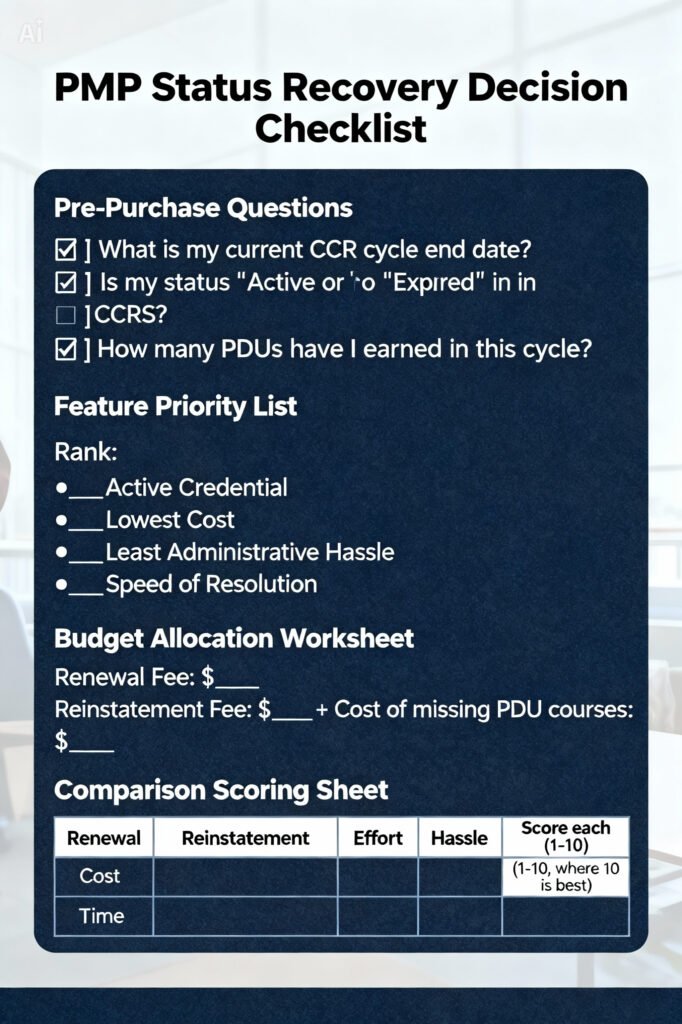
Interactive Checklist
Recommended Paths
Best Overall in Each Price Tier
- Best Overall Investment: Timely Renewal. It is the cheapest, simplest, and most professional way to maintain your credential’s value.
- Best (Only) Option for a Lapsed Credential: Reinstatement. It is the sole path back to an active status without retaking the exam.
Best for Specific Use Cases
- For the Proactive Professional: Renewal, executed 6 months before the deadline.
- For the Professional Who Just Discovered a Lapse: Reinstatement, initiated immediately upon discovery.
Best for Beginners vs. Experts
- For Beginners to the CCR Cycle: Renewal. Establish good habits from your first cycle.
- For ‘Experts’ Who Let it Lapse: Reinstatement. A hard lesson in the importance of process adherence, even for experts.
Post-Purchase Considerations
Setup and Installation Best Practices (After Reinstatement)
- Once reinstated, immediately set calendar reminders for your new cycle end date.
- Log any PDUs you earned during the reinstatement process into your new cycle.
Maintenance Schedule and Requirements
- After Renewal: Continue with the normal 3-year CCR cycle.
- After Reinstatement: You are on a brand new 3-year cycle. You must begin earning PDUs immediately to avoid another lapse.
When and How to Upgrade in the Future
The only “upgrade” after reinstatement is to never let it happen again. Use project management principles to manage your own certification as a critical project.
Frequently Asked Questions
Q1: What is the main difference between PMP renewal and reinstatement?
A: Renewal is the proactive process of completing PDUs and paying a fee to extend your active certification before it expires. Reinstatement is the reactive process to restore an expired credential, involving higher fees, earning all missed PDUs, and a formal application.
Q2: How much is the PMP reinstatement fee?
A: The reinstatement fee is set by PMI and is higher than the renewal fee. While exact figures change, it has historically been in the $150 – $300+ range. You must also pay for any courses needed to complete missing PDUs.
Q3: How long do I have to reinstate my PMP after it lapses?
A: PMI typically allows a one-year reinstatement period from your certification expiration date. After this window closes, you must reapply and pass the PMP exam again.
Q4: Can I just pay the renewal fee if my PMP is expired?
A: No. The renewal payment option is only available in your CCRS dashboard while your credential is active. Once expired, the system will only offer the reinstatement process.
Q5: Do I need to earn PDUs from my lapsed cycle for reinstatement?
A: Yes. You must earn and report all 60 PDUs for the cycle in which you lapsed. These PDUs must be earned after the lapse and reported as part of your reinstatement application.
Q6: Will my reinstated PMP have the same expiration date?
A: No. Upon successful reinstatement, PMI will issue you a new 3-year certification cycle with a new expiration date.
Q7: Is reinstatement harder than renewal?
A: Yes, significantly. It is more expensive, requires condensed PDU earning, involves manual review, and has a strict deadline. Renewal is automated and spread over three years.
Q8: What if I miss the one-year reinstatement deadline?
A: If you miss the reinstatement window, your only path to regain the PMP credential is to meet all current eligibility requirements and retake the entire PMP exam, as if you were a new candidate.
Q9: Can I use PDUs I earned before my lapse for reinstatement?
A: No. PDUs for reinstatement must be earned after your certification expiration date and within the one-year reinstatement application period.
Q10: How do I start the reinstatement process?
A: Log into your PMI CCRS dashboard. If your credential is expired, there should be a link or instructions to begin the reinstatement application. You may also need to contact PMI Customer Care.
Q11: Does a reinstated PMP look different to employers?
A: On PMI’s verification site, it will show as active. It does not show a history of lapse. However, a gap in continuous certification might be inferred if your credential’s issue date changes significantly.
Q12: Can I reinstate my PMP more than once?
A: PMI’s policy should be consulted, but typically, you are expected to maintain your credential after reinstatement. Multiple lapses may lead to denial of reinstatement or requirement to retest.
Q13: What is the fastest way to get PDUs for reinstatement?
A: Focus on “Education” PDUs: online courses with instant certificates, reading books (1 PDU/hour), and watching recorded webinars. These can be completed rapidly.
Q14: Should I just retake the exam instead of reinstating?
A: Retaking the exam is often more expensive and time-consuming than reinstatement. Reinstatement is usually the preferable path if you are within the one-year window.
Q15: Can my employer pay for my reinstatement?
A: They can, but it is less likely. Employers often see reinstatement fees as a preventable cost due to employee negligence, unlike standard renewal fees which are expected.
Don’t let your certification lapse! If you’re within the grace period, renew immediately here through your PMI CCRS dashboard. If it’s already lapsed, start the reinstatement process without delay.
External Resources:
- PMI CCRS Dashboard: The official portal to check your status and begin either process. (https://ccrs.pmi.org)
- PMI Certification Policies Page: The official source for reinstatement rules, fees, and time limits. (Link to certification policies on pmi.org)
- PMI Customer Care: For specific questions about your lapsed status and reinstatement application. (https://www.pmi.org/help/contact-us)

Leave a Reply