
What is PMP Eligibility? The Complete Definition
PMP eligibility refers to the specific, non-negotiable criteria set by the Project Management Institute (PMI) that an individual must meet before they can apply to take the Project Management Professional (PMP)® certification exam. It is a formal validation that a candidate possesses the requisite blend of formal education and substantive, hands-on project leadership experience. Understanding these PMP requirements is the critical first step on your certification journey, as applying without meeting them will result in a rejected application and forfeited fees.
Table of Contents
Core Concept Explained Simply
Think of PMP eligibility as a two-part gateway. First, you must have a certain level of formal education (a degree). Second, and more importantly, you must prove you have spent a significant number of hours leading and directing projects—not just participating in them. PMI doesn’t just want theorists; they require practitioners who have been in the trenches of project management.
Key Terminology Breakdown
- Leading and Directing Projects: This is the crucial phrase. It means you were responsible for tasks under the five process groups: Initiating, Planning, Executing, Monitoring & Controlling, and Closing. It implies ownership and accountability.
- Contact Hours: Formal education in project management topics. One contact hour = one hour of instruction. These must be completed before you apply.
- Experience Verification: The process where you list your past projects, detailing the hours spent in each process group, which may be audited by PMI.
- Eligibility Period: Your experience hours must have been accrued within the eight consecutive years prior to your application submission.
Historical Development and Current Context [UPDATE: 2026]
The PMP requirements have evolved to reflect the changing nature of project work. Historically focused on predictive (waterfall) methodology, the criteria were significantly updated to emphasize a more holistic view of project leadership, inclusive of agile and hybrid approaches. The current requirements, reaffirmed for 2026, validate a candidate’s ability to manage people, processes, and the business environment—the three domains of the modern PMP exam. This ensures the credential remains relevant and valuable in today’s dynamic professional landscape.
How PMP Eligibility Actually Works: The Mechanism
The mechanism is a structured formula where your education level determines the quantity of experience hours you need to demonstrate.
Fundamental Principles
- The Trade-Off Principle: Higher formal education reduces the required amount of professional experience. A four-year degree holder needs fewer project hours than someone with a high school diploma or associate’s degree.
- The Non-Transferable Principle: Experience hours must be unique and cannot overlap across multiple projects. You cannot count the same month’s work twice for two different projects.
- The Verifiability Principle: All claimed experience must be documented with contact information for a supervisor or manager who can verify your role and responsibilities if PMI conducts an audit.
Process Flow Visualization
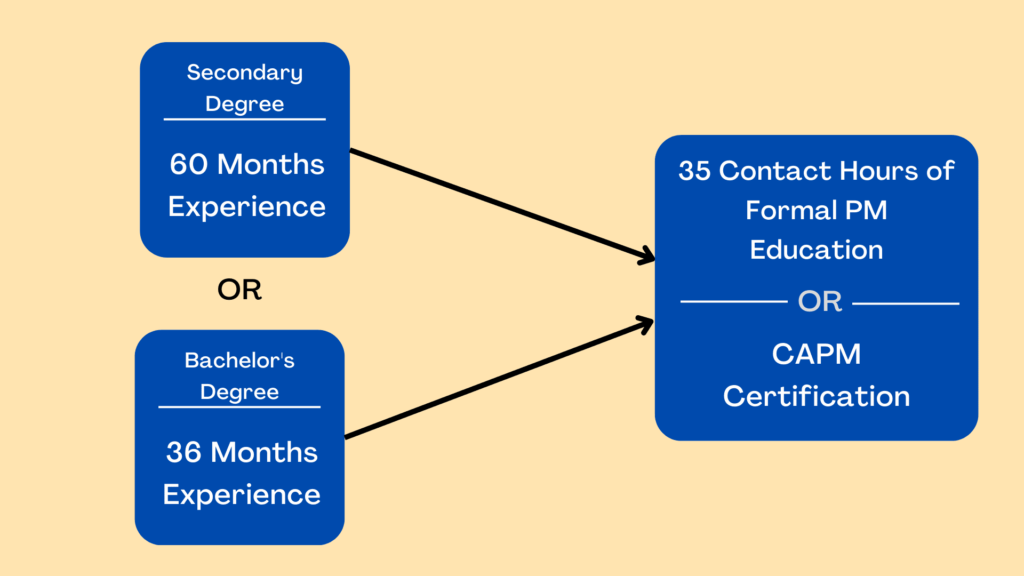
Inputs, Processes, and Outputs
- Inputs: Your academic transcripts (for education verification), detailed records of your past projects (dates, roles, hours per process group), and a certificate of completion for your 35 contact hours.
- Process: You enter this data into PMI’s online application system, which calculates totals and validates the structure. PMI may then run an audit process to verify a percentage of applications.
- Outputs: A determination of eligibility, leading to the ability to pay for and schedule the exam, or a request for an audit with further verification steps.
Components and Variations
Main Parts and Their Functions
The three core components of PMP eligibility are:
- Education Component: Serves as a baseline for professional knowledge and theory. A secondary diploma, associate’s degree, or global equivalent establishes one track; a four-year degree (bachelor’s or global equivalent) establishes a more rigorous, experience-intensive track.
- Experience Component: The heart of eligibility. It validates real-world application of project management knowledge. The months required ensure depth of experience, while the hours (4,500 or 7,500) ensure breadth and intensity of involvement.
- Education (Contact Hours) Component: Ensures all candidates, regardless of background, have received formal instruction in project management fundamentals, creating a common foundational knowledge base before sitting for the exam.
Different Models and Configurations
The two primary “models” are defined by your educational background:
- Model A (Four-Year Degree Holder):
- 36 months (or 3 years) of unique, non-overlapping experience leading and directing projects.
- 4,500 hours spent leading and directing projects within those 36 months.
- 35 Contact Hours of project management education.
- Model B (Secondary Diploma/Associate’s Degree Holder):
- 60 months (or 5 years) of unique, non-overlapping experience leading and directing projects.
- 7,500 hours spent leading and directing projects within those 60 months.
- 35 Contact Hours of project management education.
Industry-Specific Versions
While the PMP requirements are standardized globally, the nature of “projects” and “leading and directing” can manifest differently:
- IT/Software: Experience might be in leading software development sprints, managing product launches, or overseeing infrastructure upgrades.
- Construction: Experience is often in ground-up builds, renovations, or large-scale maintenance projects.
- Healthcare: Could involve implementing new patient record systems, managing clinical trials, or leading facility expansion projects.
- Marketing/Events: Includes leading campaign rollouts, product launches, or large-scale corporate events.
PMI recognizes this diversity. The key is framing your work within the framework of project processes, regardless of industry jargon.
Benefits, Applications, and Impact
Meeting the PMP requirements is more than a checkbox; it’s a transformative career milestone.
Primary Advantages and Value Proposition
Successfully navigating the PMP application process does three things: 1) It forces you to catalog and reflect on your career accomplishments, building confidence. 2) It provides an objective, third-party (PMI) validation of your professional experience, which is powerful for your resume and LinkedIn profile. 3) It unlocks access to the exam, which is the gateway to the certification’s proven salary and career advancement benefits.
Real-World Applications Across Industries
The eligibility criteria ensure the PMP credential is held by individuals who have applied theory. This is why it’s valued from finance to pharmaceuticals: a PMP holder in any industry has demonstrably led initiatives from start to finish, managed resources, navigated risks, and delivered outcomes. This universal applicability of the underlying experience is what makes the PMP so portable and respected.
Who Benefits Most and Why
- Career Project Managers: They benefit by formally validating their years of experience, often leading to immediate recognition and higher compensation.
- Career Changers/Advancers: Individuals in technical or individual contributor roles (e.g., engineers, senior developers, analysts) benefit by systematically proving they have the leadership experience to transition into formal project or program management roles.
- Consultants and Freelancers: The credential provides instant credibility with new clients, acting as a trust signal and justifying higher billing rates.
Limitations and Considerations
Potential Drawbacks and Constraints
- The Time Barrier: Accumulating 36 or 60 months of qualifying experience cannot be rushed. This excludes very early-career professionals.
- The Documentation Burden: For those who haven’t kept detailed records, reconstructing projects from years ago with accurate hour breakdowns can be challenging and time-consuming.
- The Audit Risk: The possibility of an audit (a random but mandatory process if selected) can be stressful, requiring swift coordination with past employers or clients.
Situations Where Alternatives Are Better [INTERNAL_LINK: comparison article]
The PMP is not the only path. The Certified Associate in Project Management (CAPM)® is ideal for those with less experience. It requires only a secondary diploma and 23 contact hours (or 1,500 hours of project experience), making it a perfect entry-level credential for project team members or those new to the field. [Consider the CAPM if you’re early in your project management career].
Common Misconceptions Debunked
- Misconception: “My job title must be ‘Project Manager’ to count experience.”
- Debunked: PMI cares about your responsibilities, not your title. If you led and directed project tasks (even as a “Team Lead,” “Scrum Master,” or “Coordinator”), the experience likely counts.
- Misconception: “I can count the total duration of a project (e.g., 12 months) as my experience hours.”
- Debunked: You can only count the hours you personally spent leading and directing tasks. If you worked 10 hours a week on project leadership for that 12-month project, your hours would be ~520, not the full-time equivalent.
- Misconception: “Volunteer experience doesn’t count.”
- Debunked: Volunteer project leadership experience absolutely counts if it involved the five process groups. This is a powerful way for some candidates to build qualifying hours.
Frequently Asked Questions
Q1: What are the exact PMP experience requirements for 2026?
A: If you have a four-year degree, you need 36 months (3 years) of project leadership experience with 4,500 hours. With a high school diploma or associate’s degree, you need 60 months (5 years) of experience with 7,500 hours. Both paths require 35 contact hours of project management education.
Q2: How do I calculate my project management hours for the PMP application?
A: List each unique project separately. For each project, estimate the number of hours you personally spent on tasks related to Initiating, Planning, Executing, Monitoring & Controlling, and Closing. Sum these hours across all projects to reach your total (4,500 or 7,500). Do not count overlapping time across projects.
Q3: Does my experience have to be paid?
A: No. Unpaid, volunteer project leadership experience is fully acceptable and should be documented the same way as professional experience, with a verifiable contact.
Q4: What counts as “leading and directing” projects?
A: It means you performed tasks integral to the project lifecycle. Examples: developing a charter/plan, managing budgets/schedules, leading a team, communicating with stakeholders, identifying risks, managing quality, and closing out project phases.
Q5: Can I apply for the PMP without project management experience?
A: No. The experience requirements are mandatory. If you lack the necessary hours, consider the CAPM certification as a stepping stone while you accumulate the required PMP experience.
Q6: How far back can my experience go?
A: Your experience must have been accrued within the eight consecutive years prior to your application submission. Experience older than eight years cannot be counted.
Q7: What happens if my application is audited?
A: PMI will notify you. You will have 90 days to submit signed verification forms from your contacts (supervisors/clients) for each project listed, along with copies of your diploma and contact hour certificate. Once verified, you can proceed with payment.
Q8: Do I need to submit proof of experience when I apply?
A: No, you only enter summaries. Proof (signatures, documents) is only required if your application is selected for audit.
Q9: Can I use the same experience for both the 36/60 months and the hours?
A: Yes. The months and hours are derived from the same experience. The “months” requirement ensures a minimum duration of engagement, while the “hours” requirement ensures depth of involvement within that time.
Q10: What if I can’t get a signature from a past employer?
A: This can be challenging but not insurmountable. PMI accepts verification from a colleague, client, or other professional who can confirm your work. The key is having a credible, reachable verifier. Document all attempts to contact the primary supervisor in case you need to explain the situation to PMI.
Unsure if your background qualifies? Check your eligibility now with our interactive PMP requirements calculator and step-by-step guide to documenting your experience.
4. External Resources:
- Project Management Institute (PMI) PMP Certification Page: The official, definitive source for the most current eligibility requirements, handbook, and application. (https://www.pmi.org/certifications/project-management-pmp)
- PMI’s Online Application System: The portal where candidates officially submit their experience and education for review. (https://certification.pmi.org/)
- U.S. Department of Labor’s O*NET Online – Project Management Specialists: Provides a government-standard overview of typical tasks and work activities, which can help frame your experience. (https://www.onetonline.org/link/summary/13-1082.00)

Leave a Reply