
Navigating the PMI Certification Buying Process
Choosing the right Project Management Institute (PMI) certification can feel overwhelming. With multiple credentials like PMP, CAPM, and PMI-ACP, each promising career advancement, it’s easy to make an expensive and time-consuming mistake by selecting the wrong one. The consequences are real: investing in a certification that’s too advanced (leading to frustration and failure) or too basic (failing to boost your career) can set you back months and thousands of dollars.
This definitive buyer’s guide cuts through the confusion. We’ll compare the PMP vs CAPM vs PMI-ACP across every critical factor—experience, cost, focus, and career outcome—to give you a clear, actionable framework for choosing the credential that perfectly aligns with your current role, experience level, and career aspirations. Let’s simplify your decision.
Table of Contents
Pre-Purchase Assessment: Do You Actually Need This?
Before comparing certifications, assess if you need one and which tier fits your reality.
Signs You Need a New Certification
- Career Stagnation: You’re stuck in a junior role and need a credential to be considered for project leadership positions.
- Skill Validation: You have experience but lack a formal, globally-recognized credential to prove your expertise to employers or clients.
- Industry Shift: You’re moving into an industry (e.g., tech, consulting) where certifications are expected or provide a significant competitive edge.
- Methodology Gap: Your organization is adopting Agile, and you need to demonstrate fluency to lead these projects.
Alternatives to Buying New
- Experience & Portfolio: For some roles, a strong portfolio of successful projects and references can outweigh a missing certification, especially in creative or startup environments.
- Specialized Non-PMI Certs: For highly technical fields (e.g., IT security, specific software platforms), a vendor-specific certification may offer more immediate, targeted value.
- Advanced Degree: An MBA or specialized Master’s can be an alternative for leadership tracks, though it requires more time and money.
Right-Sizing Your Purchase (Avoiding Over/Under Buying)
- Over-Buying: A junior professional attempting the PMP without the required leadership experience will face a high likelihood of application rejection or exam failure.
- Under-Buying: A seasoned Agile coach getting the CAPM would gain little value; the credential would not reflect their true expertise or command a salary premium.
Key Decision Factors and Prioritization Matrix
Evaluate these four core factors to guide your choice.
Factor 1: Budget Analysis and Price Tiers
- CAPM (Entry-Level): Total Investment: ~$600 – $1,200. Includes membership ($129), exam fee ($225 for members), and study materials. Lowest financial barrier.
- PMI-ACP (Specialist): Total Investment: ~$1,000 – $1,800. Includes membership, exam fee ($435 for members), 21 contact hours in Agile practices, and materials.
- PMP (Professional): Total Investment: ~$1,200 – $2,500. Includes membership, exam fee ($405 for members), 35 contact hours, and typically more extensive prep due to exam difficulty.
- Where to Allocate Budget: For CAPM, invest in a solid foundational course. For PMI-ACP and PMP, your largest investment should be in a high-quality practice exam bank; it’s the best predictor of success.
Factor 2: Size, Capacity, and Specifications (Experience & Education)
- How to Calculate Your Exact Needs: Honestly audit your experience against PMI’s strict requirements.
- CAPM: Requires a secondary diploma and 1,500 hours of project experience OR 23 contact hours of education. The lowest threshold.
- PMI-ACP: Requires 2,000 hours of general project experience (can overlap with PMP) + 1,500 hours working on Agile project teams (within last 3 years) + 21 contact hours in Agile topics.
- PMP: Requires 36 months/4,500 hours (with degree) or 60 months/7,500 hours (without degree) of leading and directing projects + 35 contact hours.
- Common Sizing Mistakes: Assuming all project work counts as “leading and directing” for the PMP, or underestimating the specificity of Agile experience required for the PMI-ACP.
Factor 3: Essential vs. Nice-to-Have Features (Exam Focus & Content)
- Must-Have Features (Core Knowledge Tested):
- CAPM: Foundational knowledge of PMI’s framework, terminology, and processes from the PMBOK® Guide.
- PMI-ACP: Practical application of Agile principles, practices, and tools across multiple frameworks (Scrum, Kanban, Lean, XP).
- PMP: Advanced application of project management across three domains: People (leadership), Process (technical project management), and Business Environment (strategic alignment).
- Luxury Features: Deep, esoteric knowledge of a single niche framework is not required for any of these generalist certifications.
Factor 4: Brand Reputation and Support
- Top Brand Analysis: All three are under the PMI brand, which is the global gold standard in project management. The difference is in how the market perceives each sub-brand.
- PMP Reputation: The premier, most recognized credential. Signals senior-level competence.
- PMI-ACP Reputation: The leading Agile-specific credential from PMI. Signals hands-on Agile expertise.
- CAPM Reputation: A respected entry-level credential. Signals foundational knowledge and career intent.
- Warranty and Support Comparison: All credentials require ongoing maintenance via Professional Development Units (PDUs): CAPM: 15 PDUs/3 years. PMI-ACP & PMP: 60 PDUs/3 years. PMI support and global community access are consistent across all.
Feature Breakdown Dictionary
Technical Terms Explained Simply
- Contact Hours: Hours of formal instruction. Required before applying.
- Leading and Directing (PMP): Performing tasks across the five process groups with accountability.
- Agile Experience (PMI-ACP): Time spent on project teams using iterative, incremental work methods.
- PDUs (Maintenance): Continuing education units to keep your certification active.
Marketing Hype vs. Real-World Utility
- Hype: “Get a 20% salary increase instantly!” Reality: Salary increases are linked to using the credential to secure a more advanced role, not the credential alone.
- Hype: “The CAPM is just a ‘lite PMP’.” Reality: The CAPM tests different, foundational knowledge and serves a distinct career-stage purpose.
- Hype: “The PMI-ACP is only for Scrum Masters.” Reality: It’s for any professional using Agile approaches, including product owners, developers, and project managers.
Compatibility and Integration Considerations
- Career Path Compatibility: CAPM → PMP is a logical progression. PMI-ACP can complement a PMP (showing Agile expertise) or stand alone for Agile-focused roles.
- Industry Compatibility: PMP is universally valued. PMI-ACP is highly valued in IT, software, and marketing. CAPM is useful in any industry seeking standardized PM knowledge.
- Methodology Compatibility: PMP covers predictive, Agile, and hybrid. PMI-ACP is exclusively Agile. CAPM is predictive/PMI framework-focused.
Quality Assessment Guidelines
How to Assess Build Quality In-Person
For certifications, “build quality” refers to the rigor and market recognition. Assess by:
- Reviewing the detailed exam content outline on PMI.org.
- Checking pass rates and preparation time estimates from reputable sources.
- Researching job postings in your target industry to see which credentials are requested.
Materials and Construction Standards
- PMP: Built on the PMBOK® Guide, Process Group Practice Guide, and extensive experience validation. Highest construction standard.
- PMI-ACP: Built on the Agile Practice Guide and validated Agile experience. Robust, specialist standard.
- CAPM: Built primarily on the PMBOK® Guide. Foundational standard.
Red Flags in Product Specifications
- Providers offering “guaranteed passes” or exam dumps: This is unethical and violates PMI’s code of ethics, risking revocation of your credential.
- Courses not providing contact hour certificates: Without it, you cannot apply.
- Extremely low-cost exam vouchers from unofficial resellers: Likely fraudulent.
Where and When to Buy
Retailer Comparison (Online vs. Local)
- Online (Primary Channel): PMI.org for exam registration. Third-party platforms (Udemy, Coursera, provider websites) for prep courses. Offers greatest selection and flexibility.
- Local PMI Chapters: May offer in-person bootcamps or study groups. Good for networking and structured learning.
Seasonal Buying Patterns and Best Times
- Best Times: New Year (career resolution season) and late summer (pre-Fall project cycles) often have more course promotions. PMI fees do not seasonally change.
- Worst Times: Avoid scheduling your exam during your personal or work busy seasons.
New vs. Refurbished vs. Used Analysis
- New (Primary Path): Always purchase exam vouchers directly from PMI. Always ensure your study materials are updated for the current exam outline.
- Refurbished/Used: Can apply to physical prep books (previous editions may be cheaper but verify content alignment). Never buy used exam vouchers or question bank logins.
How to Negotiate or Find Hidden Deals
- Employer Sponsorship: The best “deal.” Present a business case for why your certification benefits your company.
- PMI Membership Discount: Always join PMI first to get the member exam price.
- Bundle Deals: Some training providers bundle course + exam simulator for a discount.
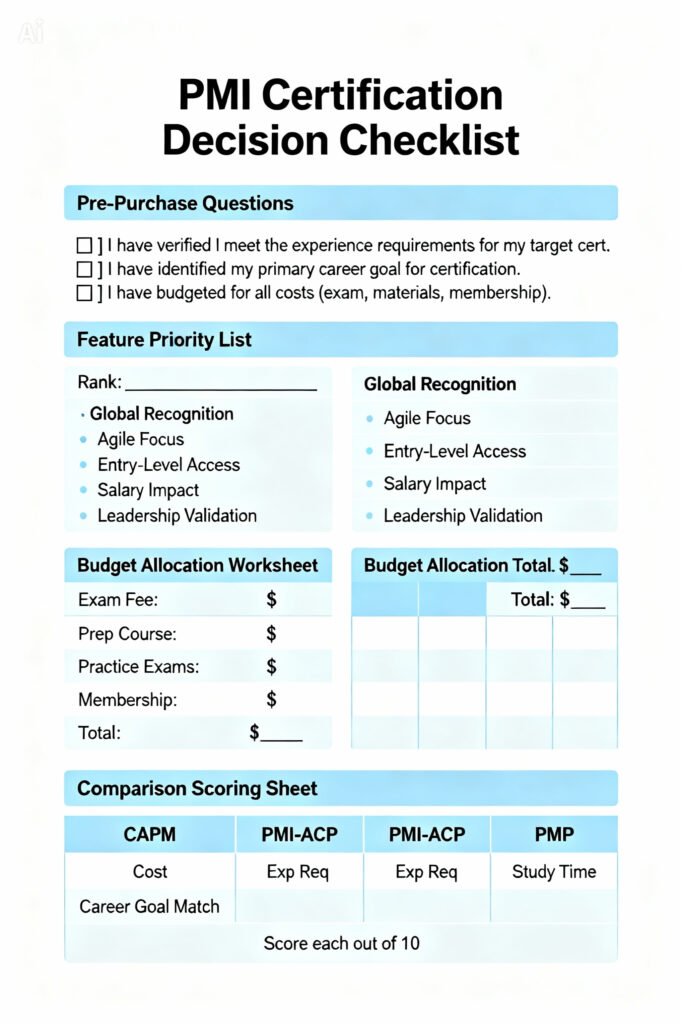
Interactive Buying Checklist
Recommended Products by Category
Best Overall in Each Price Tier
- Best Entry-Level Investment: CAPM. Ideal for those new to formal project management or career changers needing foundational credibility.
- Best Mid-Career Specialist Investment: PMI-ACP. The clear choice for professionals embedded in Agile teams who want to validate and deepen their expertise.
- Best Advanced Career Investment: PMP. The undisputed choice for project leaders seeking maximum recognition, salary potential, and career advancement across all industries.
Best for Specific Use Cases
- For IT & Software Development Professionals: PMI-ACP or PMP (depending on experience). The PMI-ACP is often a perfect fit.
- For Construction, Engineering, Government: PMP. The predictive/hybrid focus and deep process knowledge align perfectly.
- For Consultants: PMP. Provides the broadest credibility with diverse clients.
Best for Beginners vs. Experts
- Beginners/Those with <3 Years Experience: CAPM. Legitimizes your entry into the field.
- Experts/Those with >3-5 Years Leading Projects: PMP or PMI-ACP. Choose based on your methodology focus (generalist vs. Agile).
Post-Purchase Considerations
Setup and Installation Best Practices
- Immediately After Passing: Update your LinkedIn, resume, and email signature with your new credential (e.g., John Doe, PMP).
- Claim PDUs: Your exam prep may count toward initial PDUs—log them immediately in the PMI CCRS system.
- Engage with Community: Join your local PMI chapter or online forums to leverage your new network.
Maintenance Schedule and Requirements
- Create a 3-Year PDU Plan: Immediately schedule how you’ll earn 15 (CAPM) or 60 (PMP/ACP) PDUs through webinars, courses, volunteering, or creating content. Don’t wait until year three.
When and How to Upgrade in the Future
- CAPM to PMP: Once you meet the experience requirements (typically 3+ years later), the CAPM provides excellent foundational knowledge for PMP study.
- Adding PMI-ACP to PMP: A common and powerful combination. Earning the PMI-ACP after the PMP requires the 21 Agile contact hours and 1,500 hours of Agile experience.
Frequently Asked Questions
Q1: What is the main difference between PMP, CAPM, and PMI-ACP?
A: The PMP is for experienced project leaders. The CAPM is for those with little or no experience. The PMI-ACP is for professionals with hands-on Agile experience, regardless of project leadership level.
Q2: Which certification is easiest to get?
A: The CAPM has the lowest experience barrier and tests foundational knowledge, making it the most accessible. “Easiest” is relative; all require dedicated study.
Q3: Can I go straight for the PMP without getting CAPM first?
A: Absolutely. The CAPM is not a prerequisite. If you meet the PMP’s stringent experience requirements, you should pursue the PMP directly for the higher ROI.
Q4: Which certification increases salary the most?
A: The PMP consistently shows the highest salary premium globally, as it validates senior-level experience and competence.
Q5: I work exclusively in Agile. Should I get PMI-ACP or PMP?
A: The PMI-ACP is tailored for you. The modern PMP includes Agile but is a broader, generalist certification. For deep Agile credibility, the PMI-ACP is the specialist choice.
Q6: How long does it take to study for each?
A: CAPM: 40-80 hours. PMI-ACP: 60-100 hours. PMP: 150-200 hours. These vary based on your existing knowledge.
Q7: Is the CAPM worth it, or should I just wait for the PMP?
A: The CAPM is worth it if you are 2+ years away from meeting PMP experience requirements. It provides immediate resume value and foundational knowledge.
Q8: Can I maintain both PMP and PMI-ACP?
A: Yes, and efficiently. PDUs earned can often be applied to maintain both credentials simultaneously through PMI’s CCRS system.
Q9: Which exam is the hardest?
A: The PMP exam is widely considered the most challenging due to its situational, scenario-based questions, length (180 questions), and requirement for advanced application of knowledge.
Q10: Do employers value CAPM?
A: Yes, for entry-level project coordinator, junior PM, or team member roles. It shows initiative and foundational knowledge. It is not a substitute for the PMP in senior roles.
Q11: What if my experience is a mix of predictive and Agile?
A: This is very common. The PMP is likely your best fit, as its exam content and experience verification encompass both methodologies. The PMI-ACP would only validate the Agile portion.
Q12: How do I prove Agile experience for the PMI-ACP?
A: You document 1,500 hours working on Agile project teams within the last 3 years. This can include tasks like participating in sprint planning, daily stand-ups, backlog refinement, and retrospectives.
Q13: Which has more global recognition?
A: The PMP is the most globally recognized project management certification. The PMI-ACP is the most recognized PMI Agile certification. The CAPM is recognized as a valid entry-level credential.
Q14: Can I get the PMI-ACP without project management experience?
A: Sort of. You need the 1,500 hours of Agile team experience, but the 2,000 hours of general project experience can be in any role on a project (not necessarily leading it). It’s more accessible than the PMP.
Q15: What is the best first certification for a complete beginner?
A: The CAPM is designed as the first certification for individuals new to the formal discipline of project management.
Still unsure which path is right for your specific background and goals? Take our certification quiz for a personalized recommendation in under 3 minutes.
External Resources:
- PMI Certification Overview Page: The official hub to explore all certifications, their handbooks, and exam content outlines. (https://www.pmi.org/certifications)
- PMI’s Pulse of the Profession Report: Authoritative external data on trends, salaries, and the value of certifications in the project management field. (Link to latest report on pmi.org)
- Agile Alliance: A complementary, authoritative resource on Agile principles and practices, helpful for PMI-ACP candidates. (https://www.agilealliance.org/)

Leave a Reply