
Scrum is an agile framework for managing complex work, built on empirical process control (transparency, inspection, adaptation). It uses iterative Sprints (2-4 weeks) to deliver “Done” product increments. The framework is defined by three roles (Product Owner, Scrum Master, Developers), five events (Sprint, Planning, Daily Scrum, Review, Retrospective), and three artifacts (Product Backlog, Sprint Backlog, Increment).
Key Components:
- Roles: Product Owner (maximizes value), Scrum Master (facilitates process), Developers (delivers increment).
- Events: Sprint Planning (plan work), Daily Scrum (sync), Sprint Review (inspect product), Sprint Retrospective (improve process).
- Artifacts: Product Backlog (prioritized work list), Sprint Backlog (Sprint work plan), Increment (sum of “Done” work).
- Core Rule: Sprints are fixed-length and cannot be extended; unfinished work returns to the backlog.
Introduction: The Definitive Framework for Adaptive, Complex Work
Scrum is the world’s most popular agile framework, providing a structured yet flexible container for teams to tackle complex problems and deliver value in short, iterative cycles. According to the 2026 State of Agile Report, over 70% of agile teams use Scrum or a hybrid derivative, citing its clarity, focus on delivery, and built-in improvement mechanisms as key drivers of success. This guide delivers a comprehensive, actionable explanation of Scrum’s core components, how they interact, and modern implementation strategies for 2026. You will move beyond theory to understand the why behind each rule and role, enabling you to effectively adopt, coach, or participate in a Scrum team.
Prerequisites & Skill Level: This guide is for beginners, team members new to Scrum, and practitioners seeking a refresh. No prior agile experience is required. It is essential reading for developers, product managers, managers, and Scrum Masters.
Time & Cost to Implement: A team can begin practicing basic Scrum within one Sprint cycle (2-4 weeks). Mastery develops over 3-6 months. The framework is free (via the Scrum Guide). Costs arise from training, coaching, and tooling, with foundational certifications (e.g., CSM) ranging from $500-$1,500.
What is Scrum? Definition and Core Principles
Scrum is a lightweight framework that helps people, teams, and organizations generate value through adaptive solutions for complex problems. It is not a methodology with prescribed techniques but a set of rules that create an environment for empirical process control. Work is structured into fixed-length iterations called Sprints, fostering frequent inspection and adaptation.
The Three Pillars & Five Values:
- Empirical Pillars: Transparency (visible process), Inspection (frequent checks), Adaptation (timely adjustments).
- Scrum Values: Commitment, Courage, Focus, Openness, Respect. These are the behavioral norms for high-performing teams.
Bottom line: Scrum provides the “game rules” for teamwork. It doesn’t tell you how to code or design, but it ensures you are regularly building the right thing, the right way, and improving how you work.
The Scrum Framework: Roles, Events, Artifacts Diagram
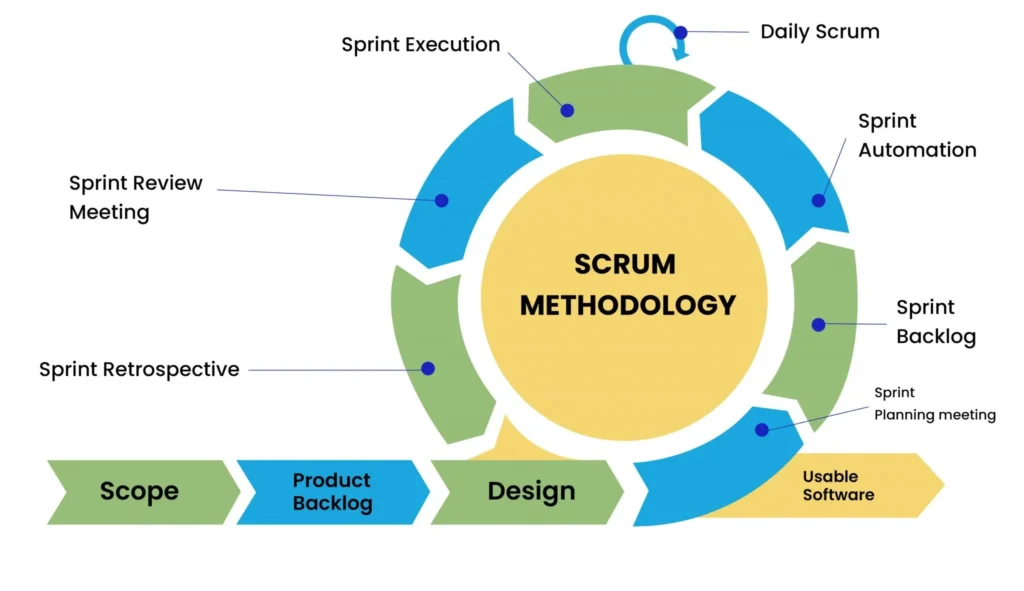
Detailed Breakdown: The 3 Scrum Roles, 5 Events, 3 Artifacts
This table synthesizes the official Scrum Guide definition with practical, modern application notes for 2026.
| Component | Official Definition & Core Accountability | Key Activities & Modern (2026) Nuances |
|---|---|---|
| Roles | Product Owner: Accountable for maximizing product value via Product Backlog management. | – Orders items by value. – Collaborates with stakeholders & team. – Modern Nuance: Uses product analytics and A/B testing data to inform backlog priorities. |
| Scrum Master: Accountable for establishing Scrum and coaching the team in Scrum theory/practice. | – Removes impediments. – Facilitates Scrum events. – Modern Nuance: Heavily focuses on remote/hybrid team dynamics and psychological safety. | |
| Developers: Accountable for creating a usable Increment each Sprint. | – Self-manage Sprint work. – Cross-functional (all skills needed). – Modern Nuance: Often includes automation engineers, DevOps, and UX as core members. | |
| Events | Sprint: Container for all other events. Fixed-length (≤1 month) to create regularity. | – Heart of Scrum. Produces a “Done” Increment. – Rule: Duration is fixed; scope can be re-negotiated if needed. |
| Sprint Planning: Plans the work for the Sprint (8-hour max for 1-month Sprint). | – Creates Sprint Goal & Sprint Backlog. – Modern Practice: Uses collaborative digital whiteboarding (Miro) for refinement. | |
| Daily Scrum: 15-min sync for Developers to plan next 24h (time-boxed). | – Focus: Progress toward Sprint Goal, adapt plan. – Remote Tip: Use video, keep it focused, not a status report. | |
| Sprint Review: Inspects the Increment and adapts Product Backlog (4-hour max). | – Informal demo to stakeholders for feedback. – Modern Practice: Recorded demos for async stakeholder input in distributed teams. | |
| Sprint Retrospective: Plans ways to increase quality and effectiveness (3-hour max). | – Inspects team process (people, relationships, tools). – Modern Nuance: Uses formats like “Start, Stop, Continue” or “Mad, Sad, Glad” with digital tools. | |
| Artifacts | Product Backlog: Ordered list of what is needed. Single source of work. | – Dynamic, never complete. Refined continuously (“Backlog Grooming”). – Modern Nuance: May be linked to strategic OKRs (Objectives and Key Results). |
| Sprint Backlog: Set of Product Backlog items selected + plan for delivering them. | – Owned by Developers. Highly visible (task board). – Modern Tooling: Managed in Jira, Azure DevOps, etc., with clear “To Do, In Progress, Done” columns. | |
| Increment: Sum of all PBIs completed in Sprint plus value of all previous increments. | – Must be in usable condition per the Definition of Done. – Key Concept: Each Increment must be potentially releasable at Product Owner’s discretion. |
Current Consensus: The most effective Scrum teams in 2026 view the framework not as a rigid set of meetings, but as a cadence for disciplined collaboration and continuous learning, with a strong emphasis on outcome-oriented Sprint Goals over mere task completion.
How to Implement Scrum: A Step-by-Step Starter Guide
Phase 1: Foundation (Week 1)
- Form the Core Team: Identify a Product Owner (with decision-making authority), a Scrum Master (with facilitation skills), and 3-9 Developers with necessary skills.
- Define the “Product” and First Goal: Agree on the product vision. Draft an initial Product Backlog (list of desired features or user stories).
- Establish the “Definition of Done”: Create a team checklist for what “Done” means (e.g., coded, tested, documented, reviewed). This is non-negotiable for quality.
Phase 2: Run Your First Sprint (Weeks 2-3 or 2-5)
- Sprint Planning (Day 1): The PO presents the goal. The team selects backlog items they believe they can complete, creating the Sprint Backlog and a forecast.
- Sprint Execution (Daily): Team works on Sprint Backlog. Hold a 15-minute Daily Scrum each day to synchronize.
- Sprint Review (Last hour of Sprint): Team demos the completed Increment to stakeholders. PO gathers feedback and updates the Product Backlog.
- Sprint Retrospective (After Review): Team discusses what went well, what didn’t, and agrees on one process improvement for the next Sprint.
Phase 3: Inspect, Adapt, and Scale (Ongoing)
- After 2-3 Sprints: Assess the team’s rhythm. Is the Definition of Done being met? Is the Sprint Goal clear?
- Consider Scaling: If multiple teams work on the same product, explore a lightweight scaling framework like Nexus to manage dependencies.
- Embrace Hybridity: If facing interrupt-driven work (e.g., support), consider adopting Scrumban by adding Kanban’s WIP limits to your Sprint board.
Common Questions Answered
Q: What is the difference between Scrum and Agile?
A: Agile is a philosophy based on values and principles (the Agile Manifesto). Scrum is a specific, prescriptive framework that operates within that philosophy, providing concrete roles, events, and rules to implement agility. You can be agile without using Scrum, but if you use Scrum, you are practicing agile.
Q: How long should a Sprint be?
A: The Scrum Guide sets a maximum of one month. The most common length is two weeks, as it balances planning overhead with feedback frequency. Start with 2 weeks, then inspect: if you need faster feedback (e.g., startup), try 1 week; if work has longer cycles (e.g., hardware), try 3-4 weeks. Never change Sprint length mid-Sprint.
Q: Who attends the Daily Scrum?
A: The Developers are required attendees. The Scrum Master ensures it happens but may not speak unless coaching. The Product Owner may attend but does not direct the meeting. It is for the Developers to plan their work, not report status to managers.
Q: Can Scrum be used for non-software projects?
A: Yes, and this is now a best practice. Scrum is a framework for managing complex work with uncertainty. It is successfully used in marketing, HR, event planning, research, and education. The “Increment” becomes a usable piece of a campaign, a process design, or a research finding.
Q: What is the Product Owner’s authority?
A: The Product Owner has ultimate authority over the what and why—the Product Backlog’s content and order. They decide what to build next. However, they do not have authority over the how or who—the Developers are self-managing and decide how to turn backlog items into an Increment.
Q: Is the Scrum Master a project manager?
A: No. The Scrum Master is a servant-leader and coach. They have no people-management authority. They serve the team by removing impediments, facilitating events, and coaching the organization on Scrum adoption. They lead the process, not the people.
Pro Tips, Pitfalls, and Scaling in 2026
Efficiency Hacks from Certified Scrum Trainers (Based on 15+ Years Experience)
- The “Sprint Goal” Hack: Before planning, the Product Owner proposes a single, objective Sprint Goal (e.g., “Enable users to reset their password securely”). The team then selects backlog items that directly contribute to that goal. This focuses the Sprint on outcome, not just output.
- The “Retrospective Prime Directive” Reminder: Start every Retrospective by reading: “Regardless of what we discover, we understand and truly believe that everyone did the best job they could, given what they knew at the time, their skills and abilities, the resources available, and the situation at hand.” This fosters safety and blame-free improvement.
- The “Virtual Board” Rule for Remote Teams: Your digital task board (Jira, etc.) must be the single source of truth. If it’s not on the board, it doesn’t exist. This maintains transparency across time zones.
Common Pitfalls and How to Avoid Them
- Pitfall: The Daily Scrum becomes a status meeting.
Solution: Refocus the conversation on the Sprint Goal. Use questions like: “What are we doing today to move the Sprint Goal forward? Are there any blockers the team needs to swarm on?” - Pitfall: The Product Backlog is a chaotic dumping ground.
Solution: Institute regular Backlog Refinement sessions (once per Sprint) where the team reviews, splits, estimates, and clarifies upcoming items to keep them “Ready.” - Pitfall: Sprints consistently fail to deliver a “Done” Increment.
Solution: Revisit and strengthen your Definition of Done. Are you over-committing? Are there hidden dependencies? Use the Retrospective to diagnose the root cause.
Scaling Scrum Beyond One Team
For multiple teams on one product:
- Start with a “Scrum of Scrums”: A representative from each team meets daily/weekly to coordinate dependencies.
- Adopt a Lightweight Framework: Use Nexus (from Ken Schwaber) which adds only a few roles (Nexus Integration Team) and events (Nexus Sprint Planning, Refinement) to base Scrum to manage cross-team integration.
- Avoid Over-Engineering: Do not adopt a heavyweight scaling framework (like SAFe) until you have mastered single-team Scrum and have a clear need for its additional structure.
Embracing Scrum as a Discipline for Value Delivery
In summary, Scrum is a deceptively simple framework that demands discipline, transparency, and a commitment to continuous improvement. Its power lies not in its individual components but in their systemic interaction, creating a predictable yet adaptable engine for delivering complex products. In the 2026 landscape, its principles are more relevant than ever for navigating volatility and fostering engaged, high-performing teams.
Final Synthesis: Research suggests that Scrum’s enduring success stems from its foundation in empiricism and human psychology. It structures the necessary feedback loops for learning and adaptation, which are the core competencies for any organization in a complex world.
Ready to start or improve your Scrum practice? Download our Free Scrum Implementation Checklist & Sprint Planning Template to guide your first 90 days.
Your Next Steps:
- Learn the Rules: Read the Official Scrum Guide (2026 Update) with our annotated commentary.
- Get Certified: Compare CSM vs. PSM I Certification Paths.
- Tool Your Team: Review the Best Agile Project Management Software for 2026.

Leave a Reply