
Agile Project Management: The Complete 2026 Guide for PMP Professionals
Quick Answer: Agile project management is an iterative approach that emphasizes customer collaboration, adaptive planning, and continuous delivery. In 2026, approximately 60% of the PMP exam uses agile or hybrid approaches across all domains.
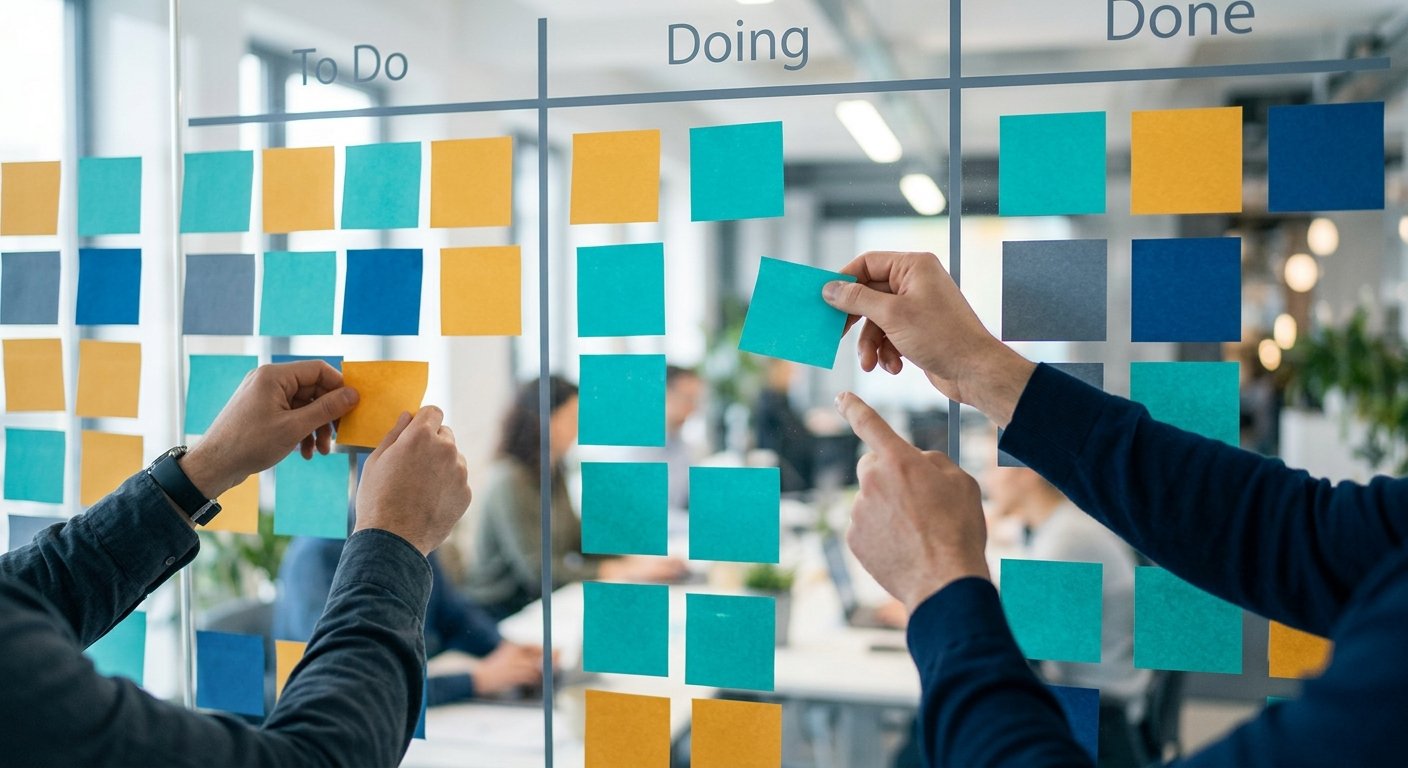
What is Agile Project Management?
Agile project management is an iterative approach that emphasizes customer collaboration, adaptive planning, and continuous delivery. Unlike traditional waterfall methods, agile breaks projects into small increments with minimal planning, delivering working software frequently.
Core Framework of Agile
While agile itself is a mindset, specific frameworks like Scrum and Kanban provide implementation structures:
| Framework | Roles | Events | Artifacts |
|---|---|---|---|
| Scrum | Product Owner, Scrum Master, Dev Team | Sprint Planning, Daily Standup, Sprint Review, Retrospective | Product Backlog, Sprint Backlog, Increment |
| Kanban | No prescribed roles | Kanban Meeting (optional) | Kanban Board, Work Items, WIP Limits |
Agile in the 2026 PMP Exam
Approximately 60% of the 2026 PMP exam uses agile or hybrid approaches, distributed across all three domains. The Process domain (41% of the exam) carries the largest volume of agile-related questions. Expect scenario-based questions on:
- Adaptive planning techniques
- Iterative delivery with stakeholder feedback
- Agile metrics like velocity and cycle time
When to Choose Pure Agile vs Hybrid
Pure agile works best when:
- Requirements are uncertain or likely to change
- The product can be delivered incrementally
- The team is co-located or highly collaborative
Hybrid approaches combine agile with predictive elements for:
- Regulated industries with mandatory documentation
- Projects with fixed-scope phases but flexible implementation
- Distributed teams needing structured coordination
Common Anti-Patterns
These practices undermine agile effectiveness:
- Sprint cramming – overcommitting to please stakeholders
- Zombie standups – mechanical updates without collaboration
- Agile theater – adopting ceremonies without cultural change
Metrics That Matter
Effective agile teams track:
- Cycle time (start to finish)
- Throughput (work completed per iteration)
- Escaped defects (quality issues reaching production)
Related Reading
Hybrid Project Management: Balancing Structure and Flexibility
Scrum vs Kanban: Choosing the Right Framework
Understanding the 2026 PMP Exam Domains
Key Takeaways
- Agile project management emphasizes iterative delivery and adaptive planning over predictive approaches.
- Approximately 60% of the 2026 PMP exam uses agile or hybrid approaches across all domains.
- Scrum and Kanban are the most common agile frameworks, each with distinct roles, events, and artifacts.
- Hybrid approaches combine agile flexibility with predictive structure when pure agile isn’t feasible.
- Effective agile teams track cycle time, throughput, and escaped defects rather than vanity metrics.
Frequently Asked Questions
Q: What is the difference between Scrum and Kanban?
A: Scrum uses fixed-length iterations (sprints) with prescribed roles and ceremonies, while Kanban is a continuous flow system visualizing work with WIP limits but no required roles or timeboxes.
Q: When should I choose hybrid over pure agile?
A: Hybrid works best when regulatory compliance requires documentation, when parts of the project have fixed scope, or when coordinating across distributed teams needing more structure than pure agile provides.
Q: How much of the 2026 PMP exam is agile or hybrid?
A: Approximately 60% of the 2026 PMP exam uses agile or hybrid approaches, distributed across all three domains (People, Process, Business Environment).
Q: What are common agile anti-patterns?
A: Anti-patterns include sprint cramming (overcommitting), zombie standups (mechanical updates without collaboration), and agile theater (adopting ceremonies without cultural change).
Q: How does agile handle risk management?
A: Agile manages risk through frequent deliverables (failing fast), continuous stakeholder feedback, and adapting priorities based on changing conditions rather than upfront exhaustive analysis.
Q: Can agile work for non-software projects?
A: Yes—agile principles apply to any complex work with uncertain requirements. Construction, marketing, and event planning all use adapted agile frameworks.